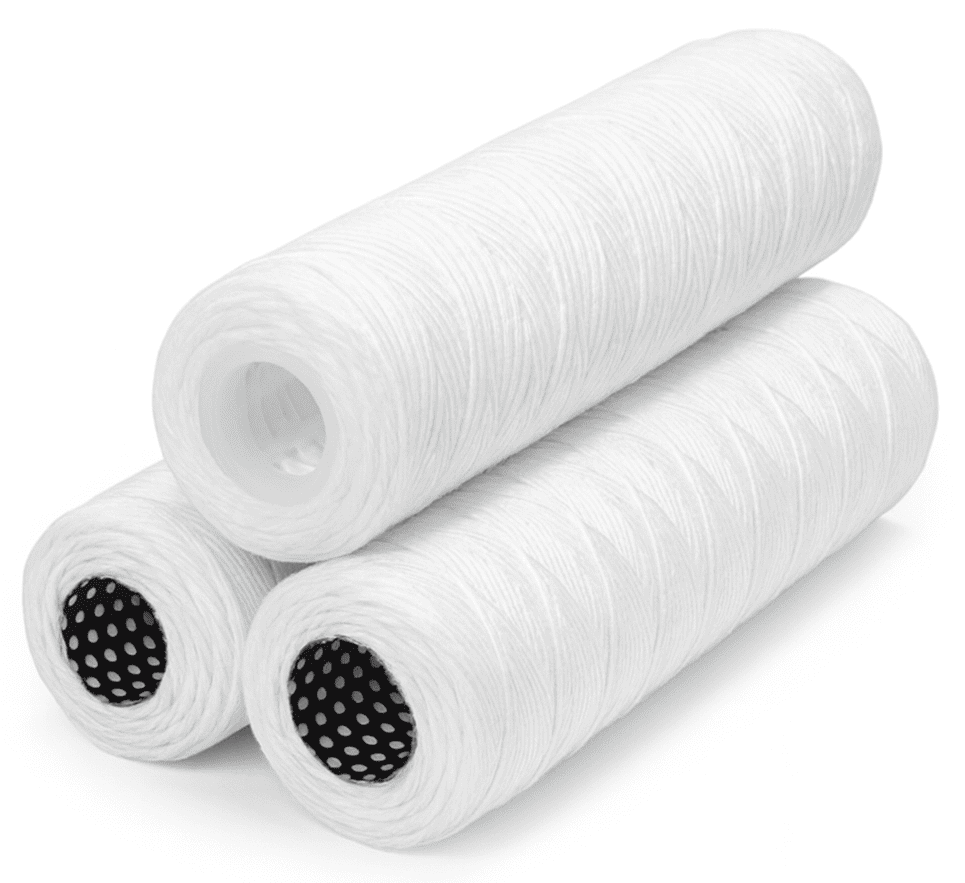


FiltraCore Asia’s LFX-CSW™ string-wound depth filter cartridges provide robust, economical and high-capacity particulate reduction for industrial water systems, utility-stream conditioning and compatible process liquids. Manufactured using binder-free precision winding, the controlled diamond-pattern winding geometry produces a true graded-porosity structure — coarse outer layers transitioning to progressively finer zones toward the core — enabling high void volume, tortuous flow paths, and exceptional dirt-holding capacity even under variable flow and solids-loading conditions.
The optimised winding tension and yarn uniformity ensure low initial differential pressure (ΔP) and stable, predictable depth-filtration performance throughout the service cycle. Available in polypropylene, cotton and glass-fibre yarns, LFX-CSW™ cartridges offer broad compatibility with industrial water, solvents, plating solutions, light chemicals and general plant utilities, making them a dependable choice for prefiltration, guard filtration and bulk solids reduction where reliability and operating economy are critical.
With industry-standard dimensions and a rigid core structure engineered for mechanical stability, LFX-CSW™ cartridges integrate seamlessly into most common filter housings.
An additional LFX-CSW™ (GAC Core) variant combines the particulate-retention performance of a precision string-wound outer layer with an internal granular activated carbon core, enabling simultaneous sediment reduction and adsorption-based reduction of chlorine, taste and odour in compatible water applications. This configuration is available as an OEM-equivalent, direct drop-in replacement for activated-carbon string-wound cartridges, including Idromar activated-carbon string-wound filter cartridges, Pentair/Pentek® RWSSC-5 Series, Atlas Filtri® FA-CA SX Series and comparable AFL activated-carbon cartridge configurations.
Available in these standardised formats, they serve as direct drop-in replacements for widely used string-wound depth cartridges from major OEMs, including Atlas Filtri® FA Series, Eaton LOFWIND™, Parker Hannifin Fulflo® SWC Series, Pentair/Pentek® WP Series, and 3M™ Micro-Klean™ CS & D Series. This ensures reliable fluid cleanliness, equipment protection and stable upstream conditioning for downstream membrane, polishing or fine-filtration stages across industrial facilities.