
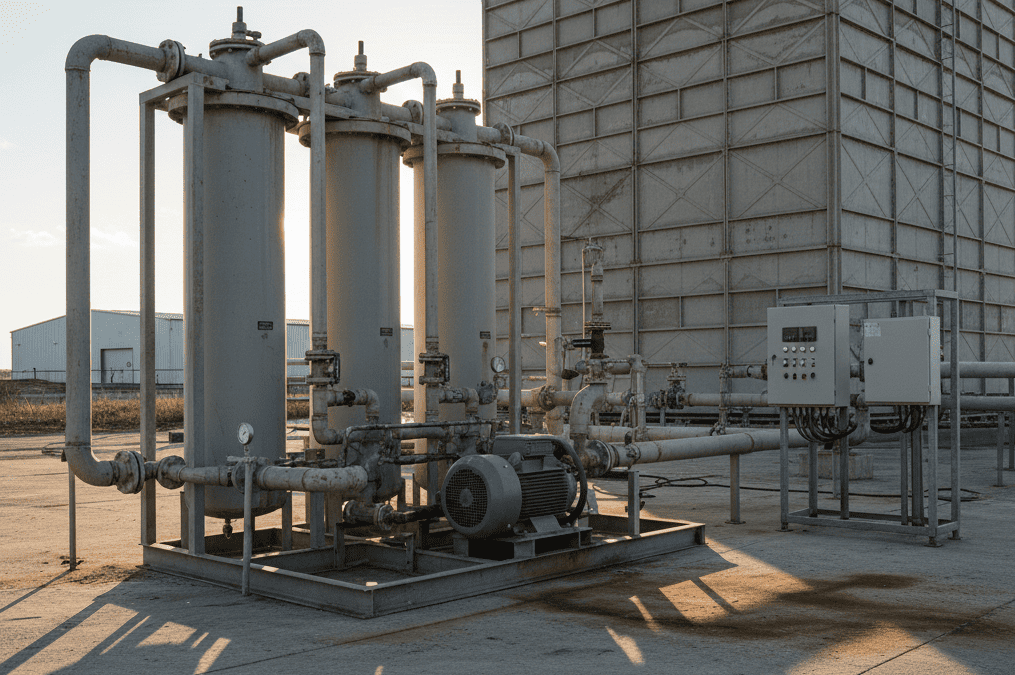
Side Stream Filtration for Cooling Towers: The Complete Engineering Guide
By FiltraCore Asia — Technical Insights Series
What Is Side Stream Filtration?
Side stream filtration is the process of diverting a controlled portion of a cooling tower’s recirculating water through a filtration system to remove suspended solids before returning it to the main loop. In modern industrial cooling water systems—especially in Asia’s tropical climates—side stream filtration has become essential for preventing fouling, corrosion, microbiological growth, and loss of heat-transfer performance.
Cooling towers continuously scrub incoming air, introducing dust, fibres, organic debris, microorganisms, pollen, biofilm fragments and airborne particulates into the water. Make-up water can contribute additional turbidity, silt, corrosion by-products, and treatment precipitates. If unmanaged, these solids accumulate and degrade cooling performance.
Why Side Stream Filtration Matters in Cooling Tower Systems
Suspended solids cause three critical operational threats: deposition, biological growth, and under-deposit corrosion.
Key engineering impacts:
• Deposition & fouling on heat-exchanger surfaces, increasing thermal resistance and ΔT
• Under-deposit corrosion driven by oxygen concentration cells
• Reduced effectiveness of corrosion inhibitors and biocides
• Microbial proliferation supported by trapped solids and organic matter
• Higher blowdown required to control solids concentration
• Frequent sump cleaning, strainer flushing, and exchanger descaling
In high-cycle or variable-water-quality systems (common in Singapore & Southeast Asia), solids loading escalates quickly—making side stream filtration one of the highest ROI interventions.
Benefits of Side Stream Filtration
1. Reduced Corrosion Rates
Removing suspended solids exposes clean metal surfaces, allowing corrosion inhibitors to work properly and reducing pitting, tuberculation, and MIC.
2. Improved Heat-Transfer Efficiency
Clean surfaces reduce fouling factors, stabilise ΔT, and lower chiller and pump energy consumption.
3. Lower Maintenance Requirements
Side stream filtration reduces the need for exchanger brushing, sump cleaning, and mechanical flushing.
4. Better Chemical Programme Performance
Biocides, dispersants, and inhibitors perform more consistently when solids no longer shield contaminants.
5. Lower Biocide Demand
Removing organic debris, dead organisms, and biofilm fragments improves biocide efficacy and reduces chemical costs.
6. Higher Cycles of Concentration
Cleaner water allows for higher cycles, reducing make-up water demand and blowdown volume.
When Side Stream Filtration Is Needed
Side stream filtration should be considered when any of the following occur:
• Make-up water comes from surface, reclaimed, or high-turbidity sources
• Biological growth persists despite a proper biocide programme
• Heat exchangers foul even with dispersants applied
• Corrosion is linked to under-deposit conditions
• Sump solids accumulate faster than expected
• High seasonal debris (pollen bursts, dust storms, cottonwood, construction areas)
• Chillers show rising approach temperatures
• Exchangers require frequent mechanical cleaning
In Southeast Asia, conditions such as monsoon seasons, tropical dust loads, and high ambient temperatures increase the frequency of these symptoms.
Types of Side Stream Filtration Technologies
1. Centrifugal Separators
Strengths:
• Excellent for heavy solids (rust, scale, sand)
• Very low maintenance
• Compact footprint
• No consumables
Limitations:
• Ineffective for organic or low-density solids
• Limited performance below ~80 microns
Best for:
Inorganic grit, high solids loading, pump protection.
2. Bag Filtration Systems
Strengths:
• Removes fine solids down to 5 microns
• Good for organic + inorganic matter
• Low capital cost
• Adjustable micron ratings (seasonal optimisation)
Limitations:
• Higher labour and maintenance
• Bags require periodic replacement
Best for:
Seasonally variable contamination, biological solids, fine silt.
3. Cartridge Filtration Systems
Strengths:
• Removes very fine solids (5 microns and below)
• Excellent polishing filtration
• Low bypass when properly sealed
Limitations:
• Higher operating cost (cartridges)
• Best for low to moderate solids loading
Best for:
Precision loops, sensitive exchangers, HVAC polishing.
4. Multimedia / Sand Filtration
Strengths:
• High throughput and stable 5-micron performance
• Long service life
• Ideal for large industrial systems
Limitations:
• Requires backwash system
• Largest footprint
• Highest capital cost
Best for:
Large cooling towers with high solids load and critical heat-transfer requirements.
Engineering Guide: Proper Sizing of Side Stream Filtration
The outdated “2% of circulation” rule is no longer adequate.
A modern engineering approach should consider:
• Solids loading (via turbidity/particle size analysis)
• Peak seasonal variations
• Target micron rating
• Tower cycles of concentration
• Basin volume & turnover
• Fouling tolerance of heat exchangers
• Integration with existing chemical treatment
General guideline:
Most industrial cooling systems achieve stable control at 5–10% of total recirculating flow.
Critical systems may require 10–15%.
Design & Integration Considerations
For maximum effectiveness, side stream filtration must be correctly integrated.
• Ideal tapping points: warm return line or basin draw
• Basin sweeping nozzles to mobilise settled solids
• Proper strainers before pumps
• Differential pressure monitoring across filters
• Chemical compatibility (oxidisers, dispersants)
• Access for bag/cartridge change-outs
• Drainage planning for backwash or maintenance
• Avoiding stagnant zones in the basin
Side stream filtration should support, not replace, chemical treatment.
Side Stream Filtration in Singapore & Southeast Asia
Cooling towers in the region face unique challenges:
• High biological activity from warm climates
• Heavy particulate load during dry seasons
• Organic debris from vegetation and storms
• Widespread use of reclaimed water
• Constant construction dust in urban industrial zones
These factors make side stream filtration a best-practice recommendation for most medium-to-large cooling systems.
Summary
Side stream filtration provides one of the highest ROI improvements in industrial cooling water management. By continuously removing suspended solids, it:
✔ Preserves heat-transfer efficiency
✔ Reduces corrosion and deposition
✔ Improves chemical treatment consistency
✔ Lowers biocide and inhibitor consumption
✔ Reduces maintenance frequency
✔ Extends equipment life and reliability
For plants facing persistent fouling, biological instability, or inconsistent water quality, side stream filtration is a proven engineering solution that stabilises cooling performance and protects critical assets.
For detailed industry guidelines, refer to Cooling Technology Institute (CTI)