Coalescing Filtration in Gas and Liquid Applications: Enhancing Separation Performance and Safeguarding Process Equipment
By FiltraCore Asia — Technical Insights Series
Introduction: Why Coalescing Filtration Matters in Process Systems
In industrial gas and liquid systems, contamination rarely appears as large, easily removed droplets. Instead, water, oil, and hydrocarbon liquids are typically present as fine aerosols or dispersed micro-droplets that pass through conventional particulate filters and separators.
Coalescing filtration is specifically engineered to address this challenge. Rather than relying on gravity or inertial separation alone, coalescing filters are designed to capture, merge, and drain fine liquid aerosols, enabling reliable separation at droplet sizes well below what mechanical separators can achieve.
As a result, coalescing filters play a critical role in protecting downstream equipment, stabilising process performance, and maintaining product or gas quality in compressed air, natural gas, and high-pressure process gas systems.
What Is a Coalescing Filter?
A coalescing filter is a specialised filtration device designed to remove liquid aerosols and fine droplets from gas or liquid streams. It operates on the principle of coalescence, where small liquid droplets are captured by fibrous media and merged into larger droplets that can be separated by gravity.
Unlike simple particulate filters, which primarily remove solid contaminants, coalescing filters are optimised for liquid removal, often achieving high separation efficiency at droplet sizes down to the sub-micron range.
Typical contaminants targeted by coalescing filters include:
-
Water aerosols
-
Oil mist
-
Condensed hydrocarbons
-
Liquid carryover from upstream processes
How Coalescing Filter Elements Work
Coalescing filter elements consist of multiple layers of engineered fibrous media with carefully controlled fibre diameters and surface properties.
As the gas or liquid stream passes through the element:
-
Initial interception captures fine liquid droplets suspended in the flow.
-
Coalescence occurs as captured droplets collide and merge on the fibre surfaces.
-
Growth and drainage follow, with enlarged droplets migrating out of the media under gravity.
-
Separated liquid is collected and drained from the filter housing.
The cleaned gas or liquid then exits the system with significantly reduced liquid content.
This process allows coalescing filters to remove liquids that would otherwise remain entrained and cause downstream issues.
Coalescing Filtration vs Conventional Separation
Conventional separators such as knock-out drums or cyclone separators rely on inertia and gravity, which are effective only for relatively large droplets. Fine aerosols typically pass through these devices unchecked.
Coalescing filters complement these systems by providing high-efficiency liquid removal, particularly where:
-
Droplet sizes are very small
-
Operating pressures are high
-
Gas velocities are elevated
-
Downstream equipment is sensitive to liquid contamination
For this reason, coalescing filtration is often installed downstream of bulk separators as a polishing and protection stage.
Key Advantages of Coalescing Filtration
Properly specified coalescing filtration delivers several critical benefits:
■ Effective removal of fine liquid aerosols, including water and oil mist
■ Protection of compressors, turbines, valves, and instrumentation
■ Reduced corrosion, fouling, and erosion in downstream systems
■ Improved gas and product quality, supporting specification compliance
■ Lower maintenance and downtime, due to reduced liquid carryover
These benefits translate directly into improved system reliability and operating cost control.
Typical Applications of Coalescing Filters
Coalescing filters are widely applied across industries where gas or liquid purity and equipment protection are critical.
Common applications include:
-
Compressed air systems, where oil and moisture must be removed to protect pneumatic equipment
-
Natural gas processing, for removal of condensed hydrocarbons and water
-
High-pressure process gas systems, including hydrogen, nitrogen, and fuel gases
-
Chemical processing, to prevent liquid carryover into reactors, compressors, or heat exchangers
-
Power generation, protecting turbines and auxiliary systems from liquid contamination
In many of these applications, coalescing filters are not optional accessories but essential process safeguards.
Engineering Considerations for Coalescing Filter Selection
Effective coalescing filtration depends on correct system design rather than nominal efficiency claims alone.
Key considerations include:
-
Operating pressure and temperature
-
Gas or liquid composition and viscosity
-
Expected liquid loading and aerosol size distribution
-
Drainage effectiveness and housing orientation
-
Differential pressure behaviour over service life
Incorrectly selected coalescing filters can flood, re-entrain liquids, or exhibit unstable pressure drop, undermining system performance.
Where FiltraCore Asia’s LFX-CLNG™ Fits
FiltraCore Asia’s LFX-CLNG™ High-Pressure Gas Coalescing Filter Cartridges are engineered for applications requiring reliable removal of liquid aerosols from compressed and process gas streams.
The LFX-CLNG™ range is designed to support:
-
Efficient coalescence of fine liquid droplets

-
Stable differential pressure behaviour
-
Compatibility with high-pressure gas service
-
Integration into industrial filter housing systems for continuous duty operation
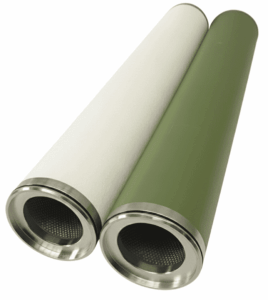
Within staged gas filtration architectures, LFX-CLNG™ cartridges are typically applied downstream of bulk separation to provide final liquid aerosol control, protecting critical downstream equipment and ensuring consistent gas quality.
Conclusion: Coalescing Filtration as a Reliability Enabler
In gas and liquid processing systems, the presence of fine liquid aerosols is a leading cause of equipment damage, corrosion, and unplanned downtime. Coalescing filtration addresses this risk by enabling high-efficiency liquid removal where conventional separation methods fall short.
When properly engineered and applied, coalescing filters become a reliability enabler, safeguarding equipment, stabilising processes, and supporting long-term operational performance across a wide range of industrial applications.
For readers who want an authoritative engineering overview of coalescing filters, ScienceDirect’s topic page on coalescing filters provides a curated summary of the underlying principles, mechanisms, and industrial applications of coalescence technology. The resource consolidates technical definitions, performance characteristics, and context for how coalescing filtration is applied in gas and liquid separation systems, complementing practical design and selection criteria discussed in this article.