

Product Consistency, Hygienic Design, Waste Management, and Water Reuse — Engineered for a Better Tomorrow
By FiltraCore Asia — Technical Insights Series
Introduction: Filtration in Jam Manufacturing Is About Control, Not Clarity
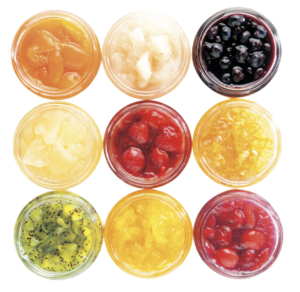 Jam and preserves manufacturing filtration is not a cosmetic step or a clarity exercise, but a critical process-control discipline governing texture, hygiene, equipment protection, waste handling, and water reuse. In practice, it is a tightly balanced operation where texture, mouthfeel, hygiene, yield, and equipment reliability are all highly sensitive to how solids, contaminants, and utilities are managed across the production line.
Filtration in this environment is not about making product “clear.” Finished jam is a high-viscosity, non-Newtonian, often thixotropic product in which fruit solids and pectin structures are intentional and essential. Filtration instead functions as a process-control discipline—protecting equipment, managing foreign-body risk, stabilising utilities, and enabling hygienic operation without damaging product integrity.
When misapplied, filtration causes immediate fouling, pressure instability, and product degradation. When engineered correctly, it quietly underpins reliable, repeatable production.
This article examines filtration in jam and preserves manufacturing from a process-engineering perspective, covering product handling, sanitary design, magnetic separation, post-processing organic waste management, and process-water recycling, with sustainability framed as an outcome of disciplined engineering.
Design Objective: Consistency, Hygiene, and Predictable Operation
The primary objective of filtration in jam and preserves manufacturing is process stability, not cosmetic improvement.
A well-engineered filtration strategy must simultaneously:
• Preserve texture and mouthfeel
• Protect pumps, heat exchangers, and fillers
• Reduce foreign-body and metallic contamination risk
• Support hygienic operation and CIP effectiveness
• Minimise product loss, waste, and unnecessary water use
Filtration decisions must therefore be driven by rheology, hygiene, and process function, not micron numbers in isolation.
In practice, effective jam and preserves manufacturing filtration requires clear separation between finished product handling, utilities, waste streams, and water-reuse loops.
Finished Product Handling: What Must Not Be Filtered
Before discussing filtration technologies, one principle must be stated unambiguously:
Finished jam or preserves must never be subjected to fine or absolute filtration.
Jam is a high-viscosity, pectin-structured product containing intentional fruit solids. Attempting to force such material through fine porous media (for example, 1-micron absolute cartridges) would result in:
• immediate filter blinding
• extreme differential pressure (ΔP) rise
• mechanical shear of pectin chains
• breakdown of gel structure
• loss of set and mouthfeel
• risk of seal or housing failure
From a fluid-dynamics perspective, the pressure required to move jam through fine media becomes impractical due to viscosity effects. Fine filtration must never be used as a texture-control step in jam production.
Finished products are instead protected using appropriately sized strainers or screens, typically in the hundreds of microns, designed to catch foreign bodies while allowing fruit pieces and pectin networks to pass unaltered.
Where Fine and Absolute Filtration Does Belong
Absolute-rated fine filtration does have a valid and important role in jam and preserves manufacturing—outside the finished-product stream.
Appropriate Applications for 1-Micron Absolute Filtration
1-micron absolute cartridges are correctly applied to low-viscosity, low-solids streams, including:
• process and service water
• recycled wash water (where permitted)
• liquid sugar solutions or syrups prior to blending
• CIP supply water
• utility side-streams requiring particulate control
In these applications, absolute filtration provides predictable retention performance without exposing product to damaging shear forces. Clear separation between product-contact streams and utility / ingredient streams is essential.
Sanitary Hardware: Filtration Is Only as Hygienic as Its Housing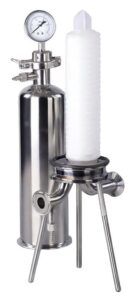
In food processing, filtration performance is meaningless without proper sanitary design.
Sanitary filter housings used in jam and preserves plants must support:
• full Clean-in-Place (CIP) coverage
• minimal dead-legs (2D rule)
• complete drainability
• appropriate internal surface finish
• food-contact-compatible elastomers
Jam’s high sugar content makes residues sticky and prone to caramelisation during cleaning. Poorly designed housings become bio-burden risks rather than safeguards. Correct orientation and hygienic geometry are therefore non-negotiable.
Magnetic Separation: The Silent Sentinel
Magnetic separators are not filters; they are foreign-body protection devices.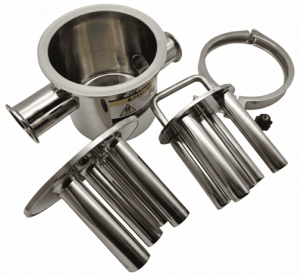
In jam manufacturing, magnetic traps intercept ferrous and weakly magnetic particles that may originate from:
• raw fruit handling
• upstream mechanical wear
• work-hardened stainless components
• maintenance activity
Magnetic separation functions as a critical preventive control, often recognised within HACCP frameworks. It protects equipment and consumers without interfering with product texture or flow, and it remains effective even when filtration media are compromised.
Post-Processing Organic Waste Handling
Managing Fruit Residues Without Creating New Risks
Jam production inevitably generates organic by-products:
• fruit skins and seeds
• fibrous pulp
• off-spec batches
• wash-down residues
If poorly managed, these materials create odour, hygiene, pest, and disposal problems.
Dewatering of Organic Solids
In non-production zones, geotextile dewatering bags provide a low-energy method of separating free water from organic solids. Their role is volume reduction and water recovery, not hygienic filtration.
Because fruit waste is typically 80–90% water, passive dewatering significantly reduces disposal volume while stabilising downstream wastewater loading. Strict physical separation from hygienic areas is essential, as organic matter will ferment rapidly if mishandled.
Process Water Recycling: Engineering for Modern Food Manufacturing
 Water conservation is a material operating concern for food processors, driven by cost, availability, and increasing regulatory and operational pressure.
In jam and preserves manufacturing, water is consumed in:
• fruit washing
• equipment wash-down
• CIP cycles
• auxiliary services
Not all of this water must be discarded after single use.
Controlled Water ReuseWith appropriate staged treatment, portions of process water can be conditionally recycled for non-critical applications such as:
• initial fruit pre-wash
• first rinse stages
• floor wash-down
A typical reuse architecture includes:
-
coarse solids removal (skins, pulp)
-
fine filtration for turbidity control
-
polishing where required for odour or colour
-
controlled pumping back into designated reuse loops
Filtration enables reuse, but does not replace hygiene controls or regulatory validation. Clear segregation between potable, product-contact, and reuse water systems is mandatory.
Differential Pressure (ΔP) Monitoring: Making Filtration Measurable
One of the most common filtration failure modes is the absence of stage-by-stage differential pressure monitoring.
Without ΔP measurement:
• operators cannot identify which element is loading
• filters are replaced blindly
• downstream media are discarded prematurely
• pressure-related failures go undetected
ΔP monitoring converts filtration from a consumables issue into a controlled process variable, enabling predictive maintenance and preserving system stability.
ESG as an Outcome of Disciplined Engineering
 True to FiltraCore Asia’s principle of “Designed for a better tomorrow™,” sustainability is treated not as a slogan, but as a consequence of good engineering.
In jam and preserves manufacturing, ESG outcomes—such as reduced water consumption, lower organic waste volumes, and improved energy efficiency—are achieved through better system design rather than aspirational targets.
By advising on hygienic filtration, clear process segregation, organic waste handling, and controlled water reuse, FiltraCore Asia goes beyond manufacturing and supply. We work with producers as a technical partner, helping design processes that are resilient, resource-efficient, and sustainable by design.
Conclusion: Filtration Is a System, Not a Component
In jam and preserves manufacturing, filtration failures rarely stem from poor filter media. They arise when filtration is treated as a component purchase rather than a process-level control strategy.
When engineered as an integrated system:
• product quality is preserved
• hygiene risks are reduced
• waste handling becomes manageable
• water use is optimised
Filtration, when applied with process understanding and discipline, supports both production performance and long-term sustainability—quietly, safely, and reliably.
For readers seeking a deeper academic understanding of filtration principles and process design in food and beverage systems, a related chapter in a scientific handbook provides detailed engineering context on unit operations, separation mechanisms, and the interplay between fluid properties and filtration media. This external resource, published via ScienceDirect, complements the applied engineering perspectives discussed above and may offer additional insights into the theoretical foundations behind effective separation and fluid handling in high-solids, high-viscosity manufacturing environments.
Related FiltraCore Solutions (Application Mapping)*
The filtration and separation principles discussed in this article are supported by FiltraCore Asia’s engineered product ranges, selected based on process role, not generic sizing.
Foreign-Body Risk Control
ACCSX-MAGSEP™ — Magnetic Separation Systems
Applied upstream of pumps and fillers to intercept ferrous and weakly magnetic contaminants arising from raw material handling, equipment wear, or maintenance activity. Suitable for hygienic food-processing environments where foreign-body risk must be controlled without affecting product texture or flow.
Adsorptive Polishing & Utility Filtration
LFX-ACT™ — Activated Carbon Filter Bags
Used for odour, colour, and organic compound reduction in process water, wash water, and reuse loops. Applied strictly outside finished-product streams, supporting water reuse and hygiene stability without imposing shear on high-viscosity products.
Process & Utility Filtration (Low-Viscosity Streams)
LFX™ Series — Liquid Filtration Solutions
Includes polypropylene and specialty filter media applied to process water, ingredient streams (e.g. liquid sugar solutions), CIP supply, and service utilities, where predictable particulate control is required under controlled hydraulic conditions.
Sanitary Filter Housings
HFX™ Series — Stainless Steel Sanitary Filter Housings
Designed for hygienic food-processing applications requiring CIP compatibility, minimal dead-legs, full drainability, and food-contact-compatible materials. Applied to utility and ingredient filtration duties where sanitary integrity is non-negotiable.
Organic Waste & Post-Process Solids Handling
ACCSX™ Series — Waste Handling & Separation Accessories
Includes solutions supporting dewatering and solids management in non-production zones, enabling volume reduction, easier disposal, and stabilised wastewater characteristics without compromising hygienic areas.
*Important Boundary
These products are applied within clearly defined process roles.
They are not interchangeable, and none are positioned as texture-control devices for finished jam or preserves.
Reliable jam production depends on filtration that is engineered, not improvised.
If you are reviewing product protection, waste handling, or process-water reuse in your operation, contact FiltraCore Asia to discuss filtration systems designed for hygienic performance, operational stability, and a better tomorrow.