Self-Cleaning Stainless Steel Filter Housings: 7 Engineering Principles for Reliable Operation
By FiltraCore Asia — Technical Insights Series
Why Automated Self-Cleaning Stainless Steel Filter Housings Exists
Automated self-cleaning stainless steel filter housings are designed for applications where continuous operation, variable solids loading, and reduced operator intervention are critical. Unlike disposable filter bags or cartridges, self-cleaning stainless steel filter housings are engineered to maintain filtration performance through automated cleaning cycles rather than manual element replacement.
They are typically deployed where stopping a process for filter changeout is operationally disruptive, labour-intensive, or economically inefficient. Over time, the value proposition shifts from consumable cost reduction to improved uptime, process stability, and predictable maintenance behaviour.
Importantly, automated self-cleaning filtration is not a single technology but a family of mechanisms, each suited to different fluids, contamination characteristics, and cleanliness targets.
Core Self-Cleaning Technologies Used in Self-Cleaning Stainless Steel Filter Housings
Automatic Backwash / Back-Flushing Screen Filters
These systems rely on surface filtration through a stainless steel screen or tubular element. As solids accumulate, differential pressure across the filter increases. When a preset threshold is reached, an automatic backwash sequence is initiated.
During cleaning, a controlled reverse-flow or isolated backwash stream removes accumulated solids from the screen surface and discharges them through a drain or reject outlet, while the main process flow is either briefly interrupted or maintained through internal flow diversion.
These designs are commonly applied in service water, cooling water, utility loops, and general industrial process water where coarse to medium filtration is required and a small reject stream is acceptable.
Suction-Scanning Screen Filters
Suction-scanning systems use a localised cleaning mechanism rather than reversing flow across the entire element. A scanning nozzle or suction head travels along the screen surface, drawing solids away through a short, high-velocity reverse-flow path.
Cleaning is typically triggered by differential pressure and occurs without taking the filter offline, making this approach well-suited for continuous, unattended operation. Because cleaning is localised, water loss during cleaning is minimal and pressure stability is generally high.
These systems are most effective in water-like fluids with relatively stable particulate characteristics.
Mechanically Cleaned Filters (Scraper, Brush, or Disc Cleaning)
Mechanical self-cleaning housings physically remove solids from the filtration surface using rotating scrapers, brushes, or cleaning discs. Instead of relying on reverse flow, solids are dislodged by direct mechanical contact and collected for discharge.
This approach is preferred where reverse-flow backwashing is undesirable or ineffective, such as in viscous liquids, sticky contaminants, oils, resins, coatings, inks, or fluids where dilution must be avoided. Mechanical cleaning allows filtration to continue while solids are continuously or periodically removed from the screen surface.
Sintered Metal and Candle-Type Cleanable Systems
For higher temperature, aggressive chemistry, or finer filtration duties, cleanable metallic media such as sintered stainless steel elements are used. These systems rely on rigid, porous metal structures that maintain fixed pore geometry and resist deformation.
Cleaning is achieved through controlled backwash, back-pulse, or pressure-assisted reverse flow. Because the media is metallic and structurally stable, repeated cleaning cycles can be performed without media degradation when properly engineered.
These systems are typically applied in critical process streams, catalyst recovery, hot fluids, or environments where disposable media would degrade rapidly.
How Automated Cleaning Is Monitored and Triggered
Differential Pressure as the Primary Control Signal
In self-cleaning stainless steel filter housings, automated cleaning is monitored and triggered through defined control logic rather than manual intervention. Pressure transmitters installed upstream and downstream of the filter continuously measure pressure loss across the filtration element.
When differential pressure rises above a predefined setpoint—indicating solids accumulation—the control system initiates a cleaning cycle. Once cleaning is complete and differential pressure returns to normal operating range, the system resumes standard filtration mode.
This approach ensures cleaning occurs based on actual fouling conditions rather than fixed time intervals, improving process stability and extending effective filtration life.
Time-Based and Hybrid Cleaning Logic
In some applications, particularly where contamination loads are predictable, cleaning cycles may be triggered on a timed basis. Hybrid strategies are also common, where time-based cleaning serves as a backup to differential pressure control, ensuring periodic cleaning even under low-load conditions.
Advanced control logic may include adjustable setpoints, cleaning duration limits, and lockout conditions to prevent excessive or unnecessary cleaning cycles.
PLC Control and Automation Integration
Automated self-cleaning filter housings are typically controlled by a programmable logic controller (PLC). The PLC manages inputs from pressure transmitters, flow sensors, valve position feedback, and motor drives, and executes cleaning sequences accordingly.
The PLC controls actuated valves, motors, or cleaning mechanisms in a defined sequence, ensuring safe and repeatable operation. Interlocks are commonly used to prevent cleaning during unsafe conditions, such as insufficient system pressure or downstream restrictions.
SCADA and Plant Control System Integration
These filtration systems are routinely integrated into plant supervisory control and data acquisition (SCADA) systems. Through SCADA integration, operators can monitor differential pressure trends, cleaning frequency, alarm status, and system health in real time.
Typical SCADA-level visibility includes filter status, active cleaning cycles, alarm notifications, historical pressure trends, and maintenance alerts. This allows maintenance and operations teams to identify abnormal fouling behaviour early and correlate filtration performance with upstream process conditions.
Integration enables filtration to become a transparent, managed asset rather than a hidden maintenance burden.
Long-Term Advantages of Automated Self-Cleaning Stainless Steel Filter Housings
Improved Uptime and Process Continuity
The long-term value of self-cleaning stainless steel filter housings lies in their ability to sustain filtration performance while reducing downtime, labour, and consumable dependency.
Reduced Lifecycle Cost in High-Load Applications
While capital cost is higher than disposable systems, automated housings reduce ongoing expenditure on consumables, labour, and downtime. In applications with persistent or variable solids loading, total cost of ownership typically favours self-cleaning systems over time.
Stable Differential Pressure and Equipment Protection
Automated cleaning maintains differential pressure within a defined operating window. This stabilises pump loading, protects downstream equipment, and reduces process upsets caused by sudden pressure spikes or bypass events.
Enhanced Safety and Housekeeping
Reduced manual intervention means fewer housing openings, less exposure to hot or hazardous fluids, and improved plant cleanliness. This is particularly valuable in chemical, oil, and wastewater services.
Predictable Waste Handling
Self-cleaning systems discharge solids in a controlled manner, allowing waste handling to be engineered and managed systematically rather than through ad-hoc disposal of spent bags or cartridges.
Practical Selection Considerations to Self-Cleaning Stainless Steel Filter Housings
Self-cleaning housings must be matched carefully to the application. Cleaning mechanisms are only effective if the contaminant can be reliably removed from the filtration surface.
Backwash systems require contaminants that can be reversed and flushed. Mechanical cleaning suits sticky or viscous solids. Sintered metal systems require validated cleaning protocols for the specific fouling chemistry.
Selection should be driven by contaminant behaviour, fluid properties, filtration target, and operational constraints rather than by automation alone.
Where FiltraCore Asia Fits
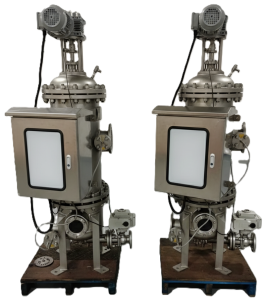
FiltraCore Asia supports automated filtration applications through its HFX-SS-AUTO™ Self-cleaning Stainless Steel Filter Housings, engineered for continuous-duty liquid filtration where reliability, maintainability, and lifecycle performance are critical. The HFX-SS-AUTO™ range is designed to address varying contaminant behaviours, process conditions, and automation requirements by offering multiple self-cleaning mechanisms within a unified stainless steel housing platform.
HFX-SS-AUTO™ configurations include backwash and backflush filter housings with internal nozzle cleaning systems, suction pad and spray nozzle self-cleaning designs for continuous operation, brush-based self-cleaning housings for viscous or sticky contaminants, mechanically cleaned strainers for coarse-to-medium filtration duties, and duplex housing variants where uninterrupted operation or redundancy is required. Across all configurations, systems are available with differential-pressure and PLC-based control logic, enabling seamless integration into plant automation and SCADA environments for condition-based cleaning, monitoring, and alarm management.
The focus is on selecting the appropriate cleaning mechanism and control strategy so that automation delivers sustained operational value rather than unnecessary system complexity.
Conclusion
Automated self-cleaning stainless steel filter housings are not simply “filters with motors.” They are integrated filtration systems that combine mechanical design, control logic, and process understanding to deliver stable, continuous filtration.
When correctly specified and integrated into plant automation systems, they reduce downtime, stabilise operation, and lower long-term operating cost. When misapplied, they become expensive hardware that still fouls.
As with all filtration decisions, success depends on engineering judgement, not automation alone.
For readers interested in a deeper academic perspective on automated filtration, cleaning mechanisms, and performance behaviour under continuous operation, a peer-reviewed study published on ScienceDirect provides additional insight. The paper examines self-cleaning filtration concepts, system design considerations, and operational performance from a research and engineering standpoint, complementing the practical, application-focused discussion presented in this article.