
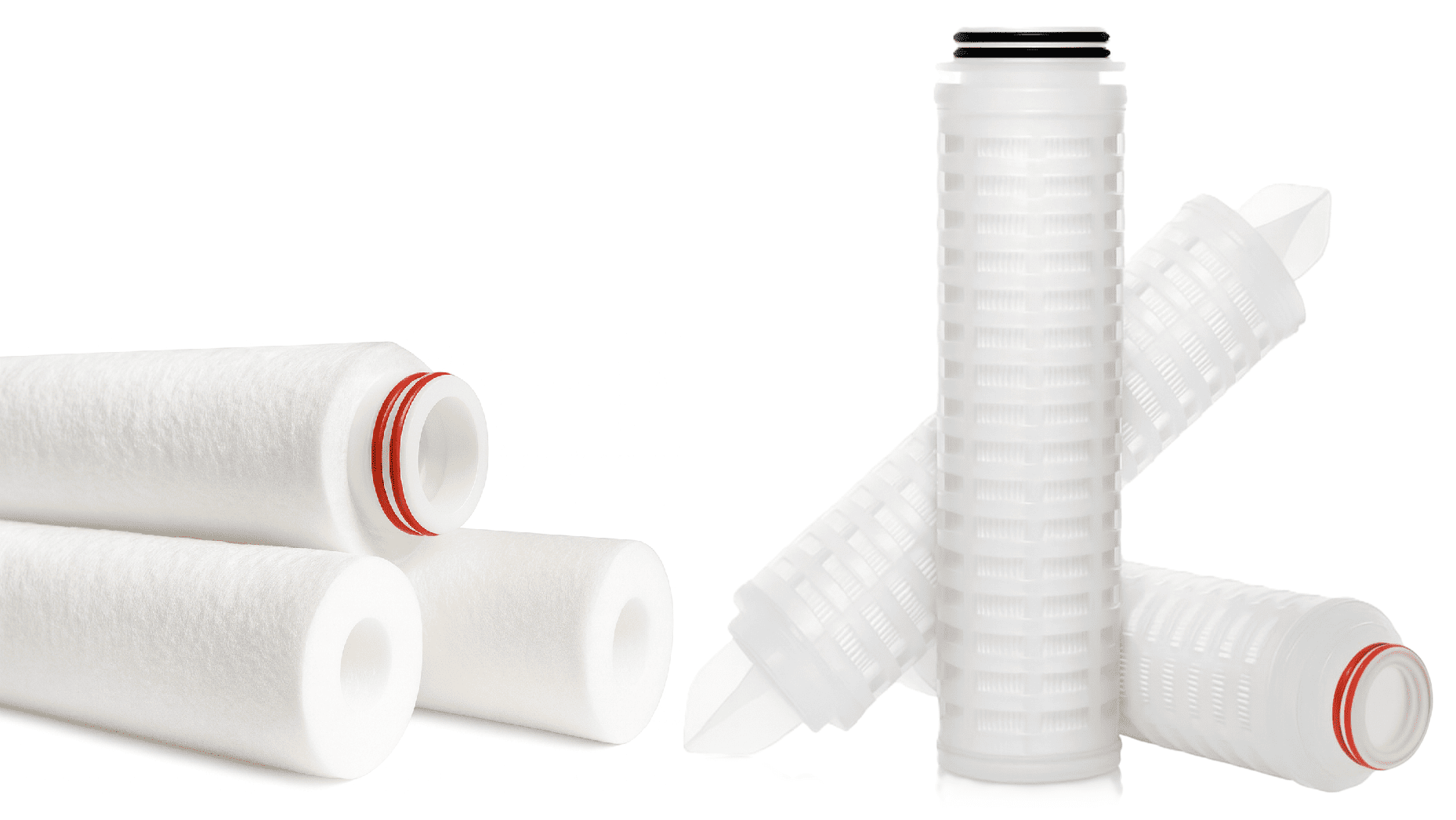
Depth and Pleated Filter Cartridges Explained: Performance Differences and Application Fit
By FiltraCore Asia — Technical Insights Series
Introduction: Understanding the Choice Between Depth vs Pleated Filter Cartridges
Choosing between depth vs pleated filter cartridges is a fundamental decision in liquid filtration system design. While both cartridge types remove particulate contaminants, they operate on different filtration principles and are suited to different process conditions, solids profiles, and performance objectives.
Misapplying cartridge type often leads to premature blockage, unstable pressure drop, inconsistent filtration performance, and unnecessary operating cost. Understanding how depth and pleated cartridges work — and where each performs best — allows engineers and operations teams to design filtration systems that are stable, predictable, and cost-effective.
Understanding Depth Filter Cartridges
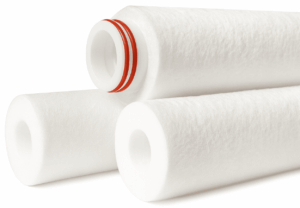
Depth filter cartridges capture contaminants throughout the full thickness of the filter media, rather than only on the surface. Particles are retained progressively: larger particles near the outer layers and finer particles deeper within the structure.
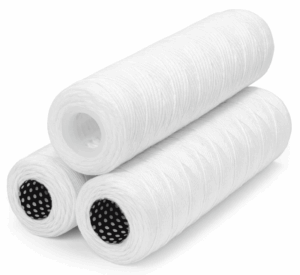
Depth cartridges are typically manufactured from materials such as polypropylene melt-blown fibres, string-wound yarns, cotton, or glass fibre, depending on chemical compatibility and temperature requirements.
Because filtration occurs throughout the media volume, depth filter cartridges offer high dirt-holding capacity and are well suited to applications with variable or heavy particulate loading.
Key characteristics of depth filter cartridges include stable pressure behaviour, tolerance to solids spikes, and consistent performance until the cartridge approaches full loading.
What Are Pleated Filter Cartridges?
Pleated filter cartridges operate primarily by surface filtration. Their pleated construction increases surface area significantly, allowing higher flow rates at lower initial pressure drop compared to non-pleated designs.
Pleated cartridges are commonly manufactured from polypropylene, polyester, nylon, or PTFE media, depending on application requirements. The pleated structure provides consistent pore geometry, making these cartridges suitable for applications requiring finer, more controlled particulate retention.
Because contaminants are captured predominantly on the surface, pleated cartridges deliver high filtration precision but typically have lower dirt-holding capacity than depth cartridges in high-solids environments.
Depth vs Pleated Filter Cartridges: Key Technical Differences
The choice between depth vs pleated filter cartridges depends on how contaminants are distributed, how stable the process conditions are, and what level of filtration precision is required.
Depth cartridges excel in handling fluids with high turbidity, variable solids loading, or inconsistent particle size distribution. Their multi-layer structure prevents rapid surface blinding and allows gradual loading across the media.
Pleated cartridges, by contrast, are best suited for relatively clean fluids where fine particulate control, clarity, and low pressure drop are critical. Their predictable retention characteristics make them ideal for polishing and final filtration duties.
In practical terms, depth cartridges prioritise capacity and robustness, while pleated cartridges prioritise precision and efficiency.
When to Choose Depth Filter Cartridges
Depth filter cartridges are typically selected for applications where the liquid contains significant suspended solids or where contaminant load fluctuates over time.
They are widely used in process water treatment, chemical processing, food and beverage production, oils and lubricants, and wastewater applications. Their ability to manage high solids loading makes them effective as pre-filters that protect downstream equipment and finer filtration stages.
Depth filtration is particularly valuable where service stability is more important than achieving very fine micron ratings at a single stage.
When to Choose Pleated Filter Cartridges
Pleated filter cartridges are ideal for applications requiring fine filtration, consistent clarity, and controlled pressure drop. They are commonly used in polishing filtration stages, final product filtration, and applications where particulate levels are already well controlled upstream.
Industries such as pharmaceuticals, electronics manufacturing, beverage processing, and ultrapure water treatment frequently rely on pleated cartridges to achieve precise particulate control.
Because pleated cartridges load primarily on the surface, they perform best in systems with low solids concentration and stable operating conditions.
Combining Depth vs Pleated Filter Cartridges in Staged Filtration
In many industrial filtration systems, the most effective approach is not choosing between depth vs pleated filter cartridges, but using both in sequence.
A depth filter cartridge is often installed upstream to remove bulk particulates and stabilise solids loading. This protects the downstream pleated cartridge, allowing it to operate within its optimal range and deliver consistent fine filtration without premature blockage.
This staged approach improves overall system reliability, extends cartridge service life, and reduces total operating cost — especially in continuous-duty or critical process applications.
Maintenance and Cost Considerations for Depth vs Pleated Filter Cartridges
Depth cartridges generally have a lower initial unit cost and are disposable by design. However, in high-solids applications, their extended service life often results in lower overall cost per unit volume filtered.
Pleated cartridges typically have a higher upfront cost but offer longer service life in clean applications and, in some cases, can be cleaned and reused depending on media type and process conditions.
Selecting the correct cartridge type based on contamination profile and process requirements is far more cost-effective than overspecifying micron ratings or relying on frequent replacements.
Where FiltraCore Asia’s LFX™ Cartridge Filtration Fits
FiltraCore Asia’s LFX™ Series is engineered to support both depth and pleated cartridge filtration requirements across industrial liquid filtration systems, enabling predictable performance across a wide range of process conditions. Within the depth filtration category, the range includes LFX-CMB™ Melt-Blown PP Depth Cartridges, LFX-CCL™ Coolant & Lubricant Melt-Blown Depth Cartridges, LFX-CSW™ String-Wound Depth Cartridges, and LFX-CBIG™ Big Blue High-Flow Depth Cartridges, each optimised for high dirt-holding capacity and upstream process stability. Complementing these are the pleated formats, led by the LFX-CPLEAT-PP™ Pleated Polypropylene Filter Cartridges, designed for fine particulate control, polishing duties, and consistent pressure behaviour in downstream stages.
In practice, LFX™ cartridges are commonly deployed within staged filtration architectures, where depth cartridges manage bulk solids and upstream variability, while pleated cartridges deliver controlled, high-efficiency particulate removal. This staged approach helps stabilise differential-pressure behaviour, extend overall cartridge service life, and reduce unplanned downtime in continuous-duty and process-critical applications.
By offering multiple cartridge constructions, micron ratings, and media options within a single, system-compatible product family, the LFX™ Series allows engineering and operations teams to match filtration performance precisely to application requirements, rather than over-specifying cartridges or relying on frequent replacements. The objective is not to promote one cartridge type over another, but to support filtration system designs that operate reliably under real-world industrial conditions.
Conclusion: Selecting the Right Cartridge for Long-Term Performance
Understanding the technical differences between depth vs pleated filter cartridges allows engineers and operations teams to make informed decisions that improve filtration stability, reduce downtime, and control operating cost.
Depth cartridges provide robustness and capacity where solids are unpredictable. Pleated cartridges deliver precision and efficiency where clarity matters. When combined correctly, they form a filtration strategy that is both resilient and precise.
Filtration performance is not defined by a single cartridge, but by how each stage supports the next — and how well the system is matched to the application.
For readers seeking a broader academic and engineering perspective on cartridge filtration technologies, ScienceDirect provides a consolidated overview of cartridge filter principles, design variations, and typical industrial applications. The resource summarises how cartridge filters are applied across process industries, highlighting the differences between depth and surface filtration mechanisms and their role in scalable, pressure-rated filtration systems.