
Activated Carbon Filtration in Industrial Systems: Engineering Control of Odours, Organics, and VOCs
By FiltraCore Asia — Technical Insights SeriesActivated Carbon Filtration Is an Engineering Control, Not a Black Box
Activated carbon filtration is widely deployed across industrial liquid and air systems, yet it is frequently misunderstood. In many plants, carbon is treated as a generic “odour remover” or last-resort polishing step, applied without sufficient consideration of adsorption kinetics, contact time, breakthrough behaviour, or system hydraulics.
In reality, activated carbon is a process-critical engineering control. When correctly specified, it provides reliable removal of dissolved organics, trace hydrocarbons, solvents, odour-causing compounds, and volatile organic compounds (VOCs). When poorly applied, it delivers inconsistent performance, short service life, and unpredictable operating cost.
This article examines activated carbon filtration from a technical and engineering perspective, focusing on adsorption fundamentals, system design variables, and correct application of activated carbon within industrial liquid and air filtration architectures.
Fundamentals of Adsorption in Activated Carbon Filtration
Activated carbon removes contaminants through physical adsorption, not mechanical filtration. Contaminant molecules adhere to the extensive internal pore structure of the carbon via van der Waals forces.
Key factors governing adsorption performance include:
• Surface area and pore size distribution
• Contaminant molecular size and polarity
• Contact time (Empty Bed Contact Time, EBCT)
• Concentration and mass loading rate
• Temperature and fluid properties
Activated carbon is inherently non-polar, making it highly effective for adsorbing “oil-like” organic molecules such as hydrocarbons, VOCs, solvents, and many odour-causing compounds. However, it is less effective against highly polar molecules—such as alcohols or ammonia—unless specialised or impregnated carbon formulations are used.
Crucially, activated carbon does not fail gradually. Once adsorption sites are saturated, breakthrough occurs, and contaminant removal efficiency drops sharply. This behaviour must be designed around, not discovered by accident.
Liquid-Phase Activated Carbon Filtration
In liquid systems, activated carbon is commonly applied for the removal of:
• Taste- and odour-causing compounds
• Dissolved organics and trace hydrocarbons
• Colour bodies and degradation by-products
• Residual solvents or process contaminants
Engineering Considerations in Liquid Applications
Performance in liquid systems is governed by contact time and hydraulic behaviour.
A typical design reference:
-
EBCT of 5–15 minutes is commonly used for organics removal in liquid applications, depending on contaminant type and concentration.
Other critical variables include:
• Flow rate and viscosity (affecting EBCT)
• Upstream particulate control to prevent pore blockage
• Carbon form factor (bag vs. cartridge) and pressure-drop tolerance
Fine solids upstream of carbon rapidly blind adsorption sites and reduce effective capacity. For this reason, activated carbon filtration is normally applied after particulate filtration, not as a primary solids removal step.
Activated Carbon Filtration: Where FiltraCore Asia Fits
FiltraCore Asia supports liquid-phase adsorption using two distinct activated carbon formats, selected based on flow regime, solids loading, and control requirements.

LFX-ACT™ — Activated Carbon Filter Bags
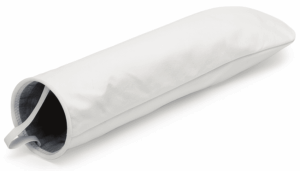
LFX-ACT™ activated carbon filter bags are suited for applications requiring bulk adsorption under higher solids loading or variable flow conditions. The bag format allows combined mechanical interception and chemical adsorption in a single step.
Typical applications include:
• Process water and utility streams
• Wastewater or reuse circuits with trace hydrocarbons
• Intermediate adsorption where pressure drop tolerance is higher
This format is particularly effective where robustness and ease of change-out are prioritised over tight hydraulic control.
LFX-CACT™ — Activated Carbon Filter Cartridges

LFX-CACT™ activated carbon filter cartridges are used where adsorption must be precisely controlled. These cartridges are available in carbon block and granular activated carbon (GAC) constructions, each with distinct engineering advantages.
• Carbon Block cartridges provide uniform flow paths and also act as a 5–10 micron sediment filter, offering combined particulate and adsorption control.
• GAC cartridges provide lower pressure drop and are better suited for higher-flow, bulk adsorption duties where sediment removal is handled upstream.
LFX-CACT™ cartridges are typically positioned downstream of particulate filtration in applications where predictable contact time, pressure stability, and consistent adsorption performance are required.
Gas-Phase and Air-Side Activated Carbon Filtration
Activated carbon is equally critical in air and gas systems, particularly for the control of:
• VOCs from industrial processes
• Solvent vapours and fumes
• Odour-causing compounds
• Trace hydrocarbons in ventilation air
Unlike liquid systems, gas-phase adsorption depends heavily on residence time and face velocity. High airflow velocity reduces adsorption efficiency, regardless of carbon mass.
As a general principle: • Air systems require much shorter residence times than liquid systems, but must operate at lower face velocities to achieve meaningful adsorption.
Activated Carbon Filtration in HVAC and Ventilation Systems

In HVAC and clean-air applications, activated carbon does not replace particulate filters. Instead, it removes gaseous contaminants that mechanical filtration cannot capture.
Engineering best practice includes:
• Installing carbon filters downstream of particulate filtration
• Controlling face velocity to preserve adsorption efficiency
• Preventing dust loading that would prematurely exhaust carbon capacity
Activated Carbon Air Filtration: Where FiltraCore Asia Fits
FiltraCore Asia supplies AFX™ air filters incorporating activated carbon media for gas-phase adsorption in HVAC and ventilation systems.
These are applied where:
• Odour control is required in occupied spaces
• VOC reduction is needed in process, packaging, or storage areas
• Gaseous contaminants must be controlled without destabilising airflow
AFX™ activated carbon air filters are used strictly for gas-phase control, not dust filtration, and are integrated as secondary or polishing stages following particulate filters.
Breakthrough, Service Life, and Why Carbon Systems Fail in Practice
The most common failure mode in activated carbon systems is poor understanding of breakthrough behaviour. Carbon performs effectively until adsorption sites are saturated, after which removal efficiency declines rapidly.
Engineering-led carbon systems therefore require:
• Defined service life assumptions
• Conservative design margins
• Replacement based on loading, not appearance
Treating activated carbon as a “fit-and-forget” consumable almost guarantees inconsistent performance and unexpected process excursions.
Integrating Activated Carbon into Staged Filtration Architectures
Activated carbon performs best when integrated into staged filtration systems:
-
Upstream particulate filtration to protect adsorption sites
-
Activated carbon adsorption for dissolved or gaseous organics
-
Downstream polishing, where required, to stabilise quality
This staged approach improves predictability, extends carbon life, and reduces overall operating cost.
Quick Reference: FiltraCore Activated Carbon Filtration Applications
| Application | Contaminant Type | Form Factor | Recommended Product |
|---|---|---|---|
| Process Water | Dissolved organics | Cartridge (carbon block) | LFX-CACT™ |
| Utility / Waste Water | Trace hydrocarbons | Filter bag (activated carbon) | LFX-ACT™ |
| HVAC / Offices | Odours, food smells | Carbon air filter | AFX™ (Activated Carbon) |
| Industrial Exhaust | VOCs, solvents | Extended carbon media | AFX™ (Pocket / Carbon) |
Conclusion: Activated Carbon Filtration as a Controlled Engineering Element
Activated carbon filtration is neither mysterious nor generic. When specified with a clear understanding of adsorption physics, contact time, contaminant chemistry, and system hydraulics, it becomes a reliable and defensible process control tool.
FiltraCore Asia’s activated carbon solutions — LFX-ACT™, LFX-CACT™, and AFX™ activated carbon air filters — are positioned within this engineering framework, supporting adsorption duties where predictability, stability, and process integrity matter more than marketing claims.
Activated carbon delivers consistent performance only when treated as an engineered element, not a commodity.
For readers seeking an authoritative engineering overview of activated carbon and its role in industrial filtration, the linked ScienceDirect topic page on activated carbon provides comprehensive context on how activated carbon’s porous structure, surface area characteristics, and adsorptive mechanisms influence its performance across fluid and gas applications. This resource explains the science behind carbon’s adsorption behaviour, including factors such as pore distribution and contaminant affinity, and complements the practical insights in this article on deploying activated carbon filtration in both liquid and air systems.