
HVAC Filtration Systems and Clean Air Control: 9 Engineering Principles for Reliable Airflow and Filtration Control
By FiltraCore Asia — Technical Insights Series
Why HVAC Filtration Is an Engineering Discipline, Not a Commodity
HVAC and clean air systems are not passive building services. They are engineered airflow control systems that directly influence indoor air quality, energy efficiency, asset lifespan, and compliance outcomes. In real buildings—commercial, industrial, and mixed-use environments—filtration failures rarely present as immediate breakdowns. Instead, they surface gradually through rising energy costs, unstable airflow, premature equipment fouling, and persistent air quality complaints.
Effective HVAC filtration must therefore be approached as a systems engineering problem, not a procurement exercise. Selecting the correct filter type, media efficiency, surface area, and pressure-drop profile requires understanding airflow physics, contaminant behaviour, and system operating envelopes.
This article examines HVAC filtration systems from an engineering perspective, focusing on airflow control, filtration strategy, and practical design decisions that determine long-term performance in real buildings.
HVAC Filtration Systems as Engineered Airflow Infrastructure
HVAC filtration systems should be understood as engineered airflow infrastructure rather than consumable accessories. In real buildings, HVAC filtration systems influence pressure balance, fan performance, coil cleanliness, and indoor air quality simultaneously. When HVAC filtration systems are incorrectly sized, poorly sealed, or inconsistently maintained, the result is unstable airflow, rising energy consumption, and uneven air distribution—regardless of the nominal filter efficiency rating.
1. Defining the Filtration Duty in HVAC Filtration Systems
The first step in HVAC filtration systems design is defining the duty. This involves identifying the dominant contaminants, expected particle size distribution, operating airflow rates, and system sensitivity to pressure variation.
In modern HVAC filtration systems, filtration duty is commonly aligned to recognised standards such as ISO 16890 or ASHRAE 52.2 (MERV). Selecting an appropriate ISO 16890 classification—such as ePM₁ or ePM₂.₅—helps ensure filter efficiency targets the particulate fraction most relevant to occupant exposure and equipment protection. The objective is not to overspecify filtration, but to match performance to the true contaminant risk and airflow requirement.
Beyond air cleanliness alone, filtration duty must account for downstream heat-transfer surfaces. Even a thin 0.5 mm layer of dust on a cooling coil can increase airflow resistance and reduce heat-transfer efficiency by up to 15 percent, directly driving higher fan power and increased chiller energy consumption. In practice, HVAC filtration systems must be designed to maintain stable airflow and predictable differential pressure behaviour across the full operating and loading range.
2. Airflow, Face Velocity, and the Consequences of Poor Selection
Airflow velocity through filter media governs both filtration efficiency and pressure behaviour. Excessive face velocity increases particle penetration, accelerates media loading, and causes unstable differential pressure rise. Undersized filters frequently appear acceptable during early operation but degrade rapidly once dust loading begins.
In HVAC filtration systems, stable airflow is critical. Filters must be sized to distribute airflow evenly across the media surface, maintaining predictable pressure rise over the service interval. Systems designed solely to minimise initial pressure drop often fail prematurely because they ignore long-term loading dynamics.
3. Predictable Differential Pressure Versus Minimal Resistance
A common misconception is that the “best” filter is the one with the lowest initial pressure drop. In reality, predictable differential pressure behaviour is far more important than minimal resistance.
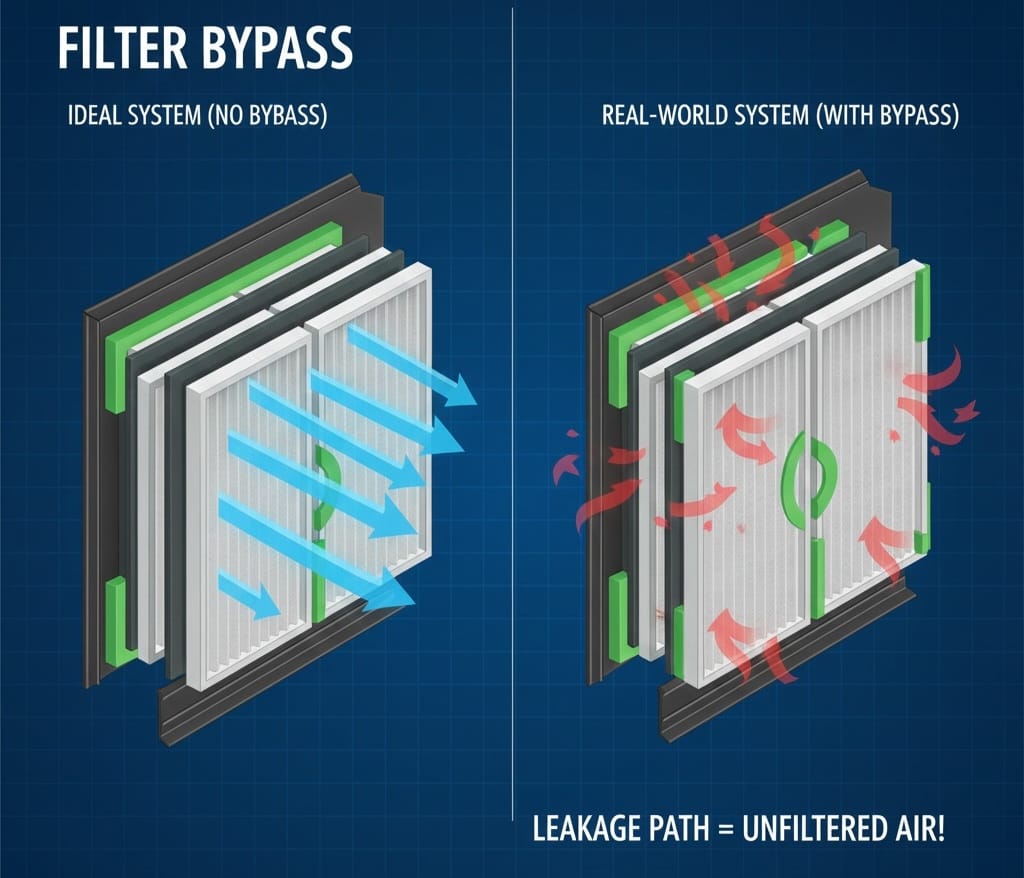
Effective HVAC filtration systems rely on controlled dust loading. A stable dust layer improves capture efficiency and slows further penetration. Filters that blind unevenly or deform under load create airflow imbalance, bypass leakage, and premature system alarms. In practice, HVAC filtration systems must be designed to maintain stable airflow and predictable differential pressure behaviour across the full operating and loading range.
4. Staged Filtration as Best Practice
High-performing HVAC filtration systems use staged filtration to manage contaminant load progressively.
Primary filtration intercepts coarse particulates at air intakes and plant rooms, protecting downstream filters from rapid loading. Secondary filtration targets finer particulate fractions responsible for coil fouling and indoor air quality degradation. Final-stage filtration, where required, stabilises supply air quality in sensitive environments.
Each stage must be engineered to complement the next. Skipping stages or overspecifying a single filter typically increases operating cost without improving performance.
5. Coil Protection, Asset Longevity, and Energy Stability
Cooling and heating coils are among the most expensive and performance-sensitive assets in HVAC systems. Fouled coils experience reduced heat transfer, higher pressure drop, and uneven temperature distribution.
HVAC filtration systems that adequately protect coils extend cleaning intervals, reduce chemical usage, and stabilise thermal performance. Over the life of a building, correct filtration selection can yield meaningful reductions in total energy consumption and maintenance expenditure.
6. Urban Fine Particulate, PM₂.₅, and Rising IAQ Expectations
In dense urban environments, fine particulate matter—particularly PM₂.₅—represents a growing challenge. These particles remain airborne for extended periods and penetrate deep into occupied spaces.
Regulators and building owners increasingly require HVAC filtration systems that explicitly address fine particulate fractions. Filters aligned with ISO 16890 ePM₂.₅ or ePM₁ classifications play a critical role in meeting evolving indoor air quality expectations without destabilising airflow or driving excessive replacement frequency.
7. Filter Media Selection and Application Matching in HVAC Filtration Systems
Different filter constructions serve distinct engineering roles within HVAC filtration systems.
Panel filters are typically deployed as primary filters at air intakes and plant rooms. Their rigid construction provides mechanical robustness and low replacement cost, making them suitable for intercepting coarse dust and debris before it reaches more sensitive downstream stages.
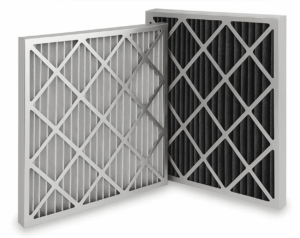
Pleated filters offer increased surface area within compact footprints. This geometry reduces face velocity and supports higher particulate capture without excessive pressure drop. They are commonly used as secondary filters in commercial and mixed-use HVAC systems where space constraints exist.
Pocket filter modules are selected where HVAC filtration systems must operate under higher face velocities and heavier particulate loading, such as industrial-adjacent buildings or dense urban environments. Their aerodynamic pocket geometry distributes airflow evenly across the media, reducing localised loading and helping prevent early blinding. This allows pocket filters to maintain stable differential pressure behaviour over extended service intervals. In practice, HVAC filtration systems must be designed to maintain stable airflow and predictable differential pressure behaviour across the full operating and loading range.
Quick Reference Table for Engineers
| Filter Type | Primary Role in HVAC Filtration Systems | Best Environment | Key Engineering Advantage |
|---|---|---|---|
| Panel (AFX-PNL™) | Coarse prefiltration | Low-dust intakes, plant rooms | Low cost, rugged construction |
| Pleated (AFX-PLT™) | General IAQ and coil protection | Commercial offices, mixed-use buildings | High surface area in compact depth |
| Pocket (AFX-PKT™) | High dust load and fine particle control | Industrial zones, urban haze environments | Longest service life, stable ΔP |
8. Capture, Conveyance, and Duct Velocity Control
Filtration performance does not exist in isolation from ductwork design. Insufficient duct velocity allows particulate matter to settle within the system, creating secondary contamination sources and potential fire risk.
Minimum transport velocity must be maintained throughout the duct network to ensure contaminants reach the filter media rather than accumulating upstream. HVAC filtration systems must therefore be evaluated as part of an integrated airflow and conveyance design, not as stand-alone consumables.
9. Where FiltraCore Asia Fits
FiltraCore Asia supports HVAC filtration systems through application-aligned filtration components designed around airflow stability, predictable pressure behaviour, and serviceability.
AFX-PNL™ panel filters are applied as primary filters in low-dust and intake environments where ruggedness and cost efficiency are required. AFX-PLT™ pleated panel filters support secondary filtration and coil protection in commercial HVAC systems, balancing surface area with compact installation. AFX-PKT™ pocket filter modules are deployed in high-load urban and industrial environments where long service life and stable differential pressure are critical.



These filtration elements are supported by appropriately engineered housings to ensure sealing integrity, controlled changeout, and consistent airflow distribution. The objective is to engineer HVAC filtration systems that perform predictably across real operating conditions, not to overspecify filtration performance.
Conclusion: Engineering HVAC Filtration Systems for Real Buildings
HVAC filtration systems in real buildings succeed only when airflow control, filtration staging, and pressure stability are engineered together rather than treated as independent variables. Systems that treat filtration as a consumable expense inevitably suffer from energy inefficiency, unstable airflow, and elevated maintenance burden.
By approaching HVAC filtration systems as a controlled engineering function—aligned with airflow physics, recognised standards, and staged protection—building operators can achieve stable indoor air quality, predictable operating costs, and long-term system reliability.
Filtration, when engineered correctly, becomes an invisible but indispensable component of high-performance buildings.
For readers seeking a foundational and engineering-focused overview of air filtration principles, the linked ScienceDirect topic page on air filtration provides an authoritative reference. This external resource explains key mechanisms of particle capture, filter media behaviour, and design considerations across a range of industrial and architectural applications. Its insights on how air filtration functions at the system level complement the technical discussions in this article on HVAC and clean air systems, helping engineers understand both theory and practical implementation.