Liquid Filter Bags: 9 Engineering Checks That Separate Commodity Bags from Premium Performance
By FiltraCore Asia – Technical Insights Series
In general industrial liquid filtration, repeated liquid filter bag failures are often dismissed as process variability, fluid chemistry issues, or unavoidable operating conditions. In reality, the majority of premature failures — leaks, bypass, unstable differential pressure, media migration, and short service life — are not caused by the process itself. They are the result of filter bag design, workmanship, and quality control discipline.
Liquid filter bags may appear deceptively simple, but their performance is governed by a series of engineering details that are easy to overlook and costly to ignore. When these details are compromised, plants experience higher downtime, inconsistent filtration results, increased maintenance effort, and avoidable operating costs.
This article outlines nine practical engineering checks that reliably differentiate commodity-grade liquid filter bags from premium, engineered alternatives — and explains why being penny wise often proves pound foolish in real operating environments.
1. Why Most Liquid Filter Bag Failures Are Not Process Problems
Check #1: Identify failure symptoms before blaming the process
Common failure symptoms in liquid filtration include:
-
Persistent leak-by at the bag collar
-
Sudden or unstable differential pressure rise
-
Shortened bag life compared to expectations
-
Media migration (fibre shedding) contaminating downstream equipment
-
Inconsistent filtration results between batches
These issues are frequently attributed to fluid variability or housing design. In many cases, however, the root cause lies in inconsistent bag construction, poor dimensional control, or inadequate seam and seal integrity. Without addressing these fundamentals, process adjustments rarely provide a lasting solution.
2. Seam Construction: Where Commodity Liquid Filter Bags Fail First
Check #2: Evaluate seam construction method and integrity
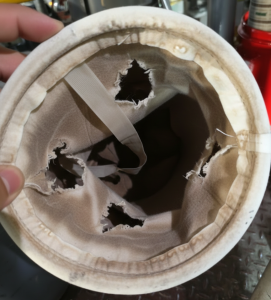 Seams are one of the most critical — and most failure-prone — elements of a liquid filter bag.
Commodity bags often rely on single-pass stitching with wide pitch and inconsistent tension. Under sustained differential pressure, this creates localised stress along the seam line, leading to stitch elongation, micro-gaps, and eventual leak-by. These failures may initially appear minor before escalating into full seam rupture.
Premium liquid filter bags use controlled seam construction, typically double-stitched with consistent stitch pitch and thread materials matched to the filter media and chemical environment. Seam straightness and tension uniformity are controlled to prevent puckering, which otherwise becomes a stress concentrator during operation.
Where applicable, ultrasonic welded seams are used in premium polypropylene liquid filter bags. Welded seams eliminate needle perforations entirely and represent the highest level of seam integrity for bypass control. In contrast, stitched commodity seams remain a common source of leakage under real operating conditions.
Across FiltraCore Asia’s LFX-PP™ and LFX-PE™ felt liquid filter bag ranges, seam construction is treated as a functional sealing interface rather than a cosmetic feature, supporting stable differential pressure and predictable service life.
3. Seal Integrity: Why “Fits” Is Not the Same as “Seals”
Check #3: Assess collar rigidity and sealing stability under pressure
A liquid filter bag that physically fits into a housing does not necessarily seal properly.
Leak-by commonly results from:
-
Inconsistent collar geometry
-
Poor flatness at the sealing face
-
Excessive flexibility or deformation under load
-
Dimensional mismatch between bag and housing tolerances
Importantly, seal failure often occurs during transient conditions — such as pump start-up, valve changes, or sudden flow surges — rather than at steady-state operation. Commodity collars frequently lack the rigidity and dimensional stability required to maintain a seal during these momentary pressure spikes.
Engineered filter bags control collar dimensions, rigidity, and sealing interface geometry to ensure repeatable sealing under both steady and transient operating conditions. This is particularly critical in felt bags such as LFX-PP™ and LFX-PE™, where seal instability can occur even at modest pressures if tolerances are poorly controlled.
4. Media Construction: Felt vs Woven Is an Engineering Choice
Check #4: Match media type to filtration duty
Choosing between felt and woven media is not a preference — it is an engineering decision.
-
Felt media provides depth filtration and higher dirt-holding capacity, suitable for variable solids loading.
-
Woven monofilament media provides precise surface filtration with well-defined pore size, ideal where particle size control, low media migration, and cleanability are required.
Using felt where woven media is required often leads to media migration (fibre shedding), unstable filtration performance, and downstream contamination. Conversely, using woven media where depth loading is required leads to rapid blinding and frequent change-outs.
FiltraCore Asia’s LFX-NMO™ woven monofilament liquid filter bags are engineered for applications where pore control, dimensional stability, and cleanliness are non-negotiable.
5. GSM: Why the Number Alone Means Nothing
Check #5: Look beyond GSM to surface treatment and uniformity
Grams per square metre (GSM) is often used as a shorthand indicator of filter bag quality. On its own, it is meaningless.
What matters is:
-
GSM consistency across the bag
-
Fibre orientation and bonding quality
-
Uniform density without thin spots or hard zones
Premium felt media is typically calendered or singed to lock surface fibres in place. A high-GSM bag without proper calendering often exhibits greater media migration than a lighter, well-treated felt. Low-grade bags commonly show GSM variability, leading to uneven loading, premature blinding, and unpredictable differential pressure behaviour.
6. Dimensional Tolerance: The Silent Cause of Bypass
Check #6: Verify dimensional consistency, not nominal size
Small dimensional deviations have large consequences.
Variations in bag length, diameter, or collar concentricity can create bypass paths, uneven loading, and seal instability. Differences of just a few millimetres are sufficient to cause leak-by in standard housings.
Engineered liquid filter bags are produced to tight dimensional tolerances, ensuring consistent fit, proper sealing, and repeatable performance across change-outs.
7. Media Migration and Fibre Shedding: The Hidden Contamination Risk
Check #7: Assess media stability under flow
Media migration (commonly referred to as fibre shedding) is a frequent but underappreciated failure mode.
Low-grade felt with inconsistent fibre bonding can release fibres into the process stream, contaminating downstream equipment, coatings, or products. This issue is often discovered only after quality problems emerge.
Premium liquid filter bags control fibre bonding, surface treatment, and media stability to minimise migration — particularly important in recirculating systems and general industrial liquid processes.
8. QA and Traceability: Why “Looks OK” Is Not a System
Check #8: Evaluate quality controls beyond visual inspection
Visual inspection alone is not quality assurance.
Reliable liquid filter bag performance depends on:
-
Incoming media inspection
-
Seam integrity checks
-
Dimensional verification
-
Batch traceability and rejection discipline
Without these controls, inconsistent performance between batches is inevitable.
At FiltraCore Asia, liquid filter bags are governed by Singapore-based governance discipline, influenced by Japanese Kodawari attention to detail and aligned with global American and European MNC engineering practices. This ensures workmanship consistency, traceability, and long-term reliability — not just initial acceptability.
9. Total Cost of Ownership: Why Cheap Bags Cost More
Check #9: Evaluate operating cost, not purchase price
The true cost of a liquid filter bag includes:
-
Unplanned downtime
-
Labour for frequent change-outs
-
Product loss from bypass or contamination
-
Increased cleaning and maintenance effort
-
Safety and environmental risk
A lower purchase price rarely offsets these costs. In many cases, premium liquid filter bags deliver lower total operating cost simply by performing reliably and predictably.
How FiltraCore Applies This Across LFX-PP™, LFX-PE™, and LFX-NMO™
Across its liquid filtration portfolio, FiltraCore Asia applies the same underlying engineering discipline and quality controls, regardless of media type or application. The examples below — LFX-PP™, LFX-PE™, and LFX-NMO™ — are referenced not because they are exceptions, but because they represent industry workhorse formats commonly used across general industrial liquid filtration.
-
LFX-PP™ illustrates how polypropylene felt liquid filter bags are engineered for stable depth filtration, with controlled seam construction, consistent dimensional tolerances, and sealing interfaces designed to minimise leak-by under real operating conditions.
-
LFX-PE™ reflects the same design and QA philosophy applied to polyester felt media, where improved mechanical strength, abrasion resistance, and durability are required in more demanding industrial environments.
-
LFX-NMO™ demonstrates how woven monofilament liquid filter bags are produced for precision surface filtration, where pore size control, dimensional stability, and low media migration are critical to performance.
These examples are representative of how FiltraCore Asia approaches liquid filter bag engineering as a whole. The same attention to media selection, seam integrity, sealing geometry, dimensional control, and batch-level QA is applied consistently across the wider LFX™ liquid filtration range.
This approach is shaped by FiltraCore Asia’s Japanese Kodawari–influenced workmanship philosophy, where precision, repeatability, and respect for details that are not immediately visible are treated as essential rather than optional. It is reinforced by Singapore-based governance discipline, where documentation, traceability, and quality accountability are embedded into how products are specified and released. Layered onto this is technical benchmarking aligned with American and European multinational engineering practices, ensuring that performance expectations remain grounded in how serious industrial operators evaluate risk and reliability.
The result is not a collection of “premium” SKUs, but a consistent engineering standard applied across product lines. This is also why FiltraCore Asia is often engaged not merely to supply liquid filter bags, but to provide technical guidance and engineering judgement — particularly in environments where cutting corners on filtration quality leads to disproportionate operational and quality risks.
In liquid filtration, reliability is rarely achieved through lowest-cost sourcing. It is achieved through disciplined engineering, controlled workmanship, and the willingness to say no to shortcuts that compromise long-term performance. That mindset defines how FiltraCore Asia approaches liquid filter bag manufacturing and selection.
For readers who want a broader engineering overview of liquid filtration principles, ScienceDirect’s topic page on liquid filtration provides a structured summary of filtration mechanisms, media types, and performance considerations commonly referenced in industrial applications. This external resource helps contextualise how media structure, flow behaviour, and contaminant capture influence filtration performance — the same fundamentals that underpin evaluation of liquid filter bag construction, seam integrity, media stability, and long-term operating reliability.
If your liquid filter bags are leaking, blinding early, shedding media, or delivering inconsistent results, the issue is rarely the process alone.
Speak with FiltraCore Asia’s technical team to review filter bag selection, construction, and QA factors before minor issues become major operational problems.