Staged Solids Control, Thermal Effects, Hydraulic Stability, and Adsorptive Polishing
By FiltraCore Asia — Technical Insights Series
Introduction: Why High-Solids Wastewater Cannot Be “Simply Filtered”
Industrial wastewater recirculation filtration in high-solids processing environments cannot be treated as a simple filtration problem.
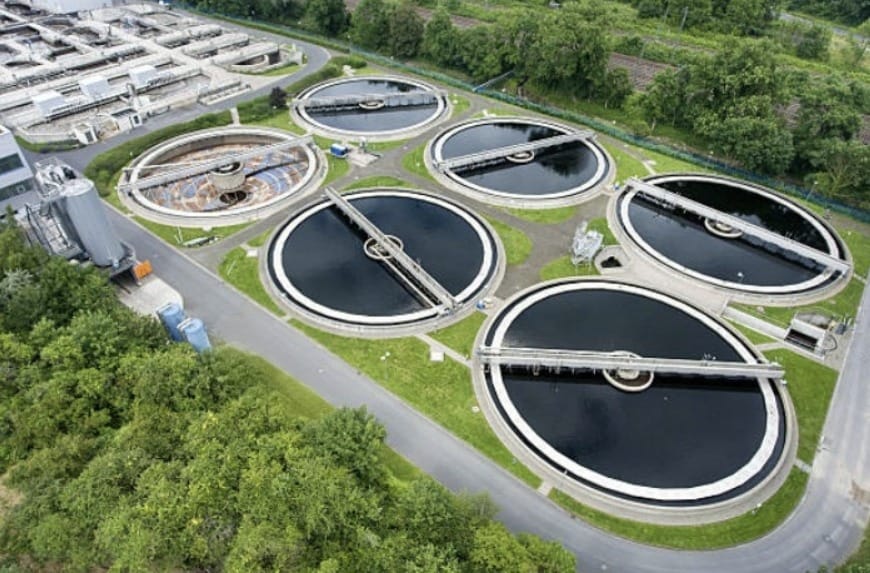
Industrial operations that rely on open systems, bulk materials, or aggressive washing processes generate wastewater with extreme and unpredictable variability. Suspended solids, grit, fibres, fines, colour bodies, dissolved organics, odour-causing compounds, and volatile organic compounds (VOCs) often coexist in the same stream, with loading that fluctuates continuously rather than gradually.
Attempts to manage this complexity with single-stage or overly fine filtration almost always fail. Filters blind prematurely, differential pressure becomes unstable, operating cost escalates, and recirculation reliability collapses.
In practice, industrial wastewater recirculation filtration succeeds only when filtration is engineered as a staged and instrumented control system, where each stage performs a clearly defined function and protects the next. This article examines such a system from an engineering perspective, with particular focus on micron strategy, temperature effects, sacrificial versus polishing media, and the correct application of activated carbon.
Design Objective: Recirculation Stability, Not Cosmetic Clarity
The primary objective in industrial wastewater recirculation filtration systems is stable recirculation back into the process, not discharge compliance or laboratory-grade clarity.
This distinction defines the filtration philosophy. Flow stability takes precedence over visual appearance. Filtration must tolerate shock loading and solids variability. Pressure behaviour must remain predictable and measurable. Polishing stages must be protected from particulate fouling.
Filtration is therefore designed from the solids load downward, not from the polishing requirement upward.
Stage 1 – Coarse Solids Interception
Mechanical Protection, Not Filtration
The first stage addresses debris and high-mass solids that would immediately destabilise downstream filtration.
Typical technologies include strainer baskets and coarse mesh elements. Their engineering function is simple but essential: intercept rocks, debris, fibres, and agglomerates with minimal pressure sensitivity and straightforward maintenance.
This stage removes materials that should never reach a filter bag. Treating coarse debris as a filtration problem rather than a mechanical interception problem simply transfers failure downstream — a common root cause of instability in poorly designed industrial wastewater recirculation filtration systems.
Stage 2 – Bulk Suspended Solids Reduction
Sacrificial Load-Bearing Filtration Using Polypropylene (PP) Bags
Once coarse solids are removed, the system enters its first true filtration stage.
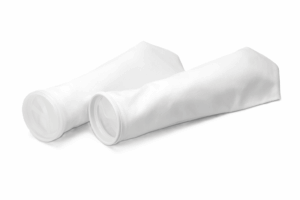
LFX-PP™ Polypropylene (PP) filter bags are deployed as sacrificial, load-bearing elements, typically in the 50–200 µm range, selected based on solids morphology rather than target clarity.
At this stage, the engineering objective is survivability. PP bags absorb high and variable suspended-solids loading, capture fibres, grit, and coarse fines, and damp upstream variability. Using finer media here would result in rapid surface blinding, steep differential-pressure escalation, and unstable flow.
These bags are not expected to last. They are expected to fail predictably, protecting downstream stages from shock loading.
Stage 3 – Fine Suspended Solids Control
Hydraulic Stabilisation Before Polishing
After bulk solids are reduced, residual fines must be controlled to stabilise hydraulics and protect adsorption media.
Finer-rated PP filter bags, typically in the 10–25 µm range, are applied at this stage. Their role is no longer shock absorption but system conditioning. They remove remaining suspended fines, stabilise turbidity, and prevent particulate fouling of activated carbon.
Skipping this intermediate stage is one of the most common causes of premature adsorption failure in industrial wastewater recirculation filtration applications.
Micron Strategy: Why “Finer” Is Not a Linear Objective
In high-solids industrial wastewater recirculation filtration, micron selection must follow functional intent, not a linear progression toward ever-smaller ratings.
Coarse PP bags absorb variability.
Finer PP bags stabilise hydraulics.
Adsorptive media address dissolved-phase contaminants.
Attempting to collapse these roles into fewer stages increases fouling, cost, and operational instability.
Thermal Effects in High-Temperature Wash-Water Filtration
Why Temperature Changes Filtration Behaviour
In many industrial washing and recycling processes, wastewater temperatures typically operate in the 60–80 °C range. At these temperatures, filtration performance is influenced by two opposing thermal effects that must be engineered deliberately.
From a hydraulic perspective, elevated temperature reduces water viscosity. This improves flow through PP filter bags and lowers baseline pressure drop, allowing sacrificial solids filtration to tolerate higher loading without rapid ΔP escalation.
From an adsorption perspective, elevated temperature reduces the adsorption efficiency of activated carbon. Physical adsorption is an exothermic process; increasing temperature weakens the interaction between dissolved organic molecules and carbon pore surfaces, shortening adsorption equilibrium time and accelerating breakthrough.
This thermal interference is a critical design consideration in industrial wastewater recirculation filtration, requiring functional separation between solids removal and adsorption stages.
Stage 4 – Adsorptive Polishing
Activated Carbon as an Engineered Control Element

Only after suspended solids are controlled does the system transition from mechanical separation to chemical adsorption.
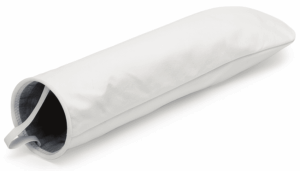
LFX-ACT™ activated carbon filter bags are applied at this final stage for the removal of dissolved organics, VOCs, odour-causing compounds, and colour bodies.
Activated carbon bags are not solids filters. They are adsorption devices. Using them upstream of adequate solids control blocks pore structures, destroys effective surface area, and renders service life unpredictable.
In high-temperature wash-loop applications, activated carbon functions as a controlled polishing element, not a bulk treatment medium.
Sacrificial Versus Polishing Media — A Functional Distinction
| Parameter | LFX-PP™ Polypropylene Filter Bags | LFX-ACT™ Activated Carbon Bags |
|---|---|---|
| Primary mechanism | Mechanical interception | Physical adsorption |
| Intended loading | High solids | Low solids, dissolved contaminants |
| Fouling tolerance | High | Low |
| Cost logic | Sacrificial | Value-preserving |
| Failure behaviour | Gradual ΔP rise | Sharp adsorption breakthrough |
Preserving this distinction is central to controlling operating cost and performance.
Application Context: PET Recycling and rPET Pellet Manufacturing
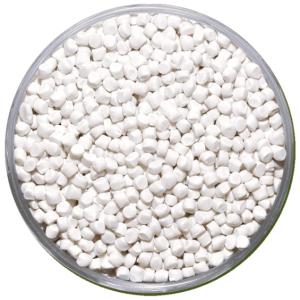
PET recycling wash-water systems are a representative example of industrial wastewater recirculation filtration under severe operating conditions.
These systems exhibit high suspended-solids variability, paper fibres and label pulp, fine grit, adhesives, inks, colour bodies, and dissolved organics. The objective is consistent recirculation back into the washing process, not discharge.
The same staged architecture applies directly, with coarse interception protecting equipment, sacrificial PP bags absorbing solids load, finer PP bags stabilising hydraulics, and activated carbon polishing dissolved contaminants that mechanical filtration cannot remove.
ΔP Monitoring: Filtration Is Not Controllable Without Measurement
One of the most common operational failures in staged industrial wastewater recirculation filtration systems is the absence of stage-by-stage differential pressure monitoring.
Without pressure indication across each filtration stage, operators cannot identify which stage is loading. Filter changes become reactive, all media are replaced simultaneously “to be safe”, and the economic benefit of sacrificial filtration is lost.
ΔP monitoring transforms filtration from a consumables problem into a controlled operating variable.
Conclusion: Filtration Is a System, Not a Product
High-solids wastewater recirculation systems do not fail because filters are inadequate. They fail because filters are asked to perform incompatible roles.
Sacrificial media must absorb variability.
Polishing media must be protected.
Adsorption must be engineered, not improvised.
When industrial wastewater recirculation filtration is treated as a staged, instrumented system rather than a product selection exercise, stability, predictability, and lower total operating cost follow naturally.
External Reference (Further Reading)
For readers interested in peer-reviewed research on advanced wastewater treatment and adsorption phenomena in industrial systems, an article hosted on ScienceDirect provides a useful complementary perspective on contaminant behaviour and adsorption dynamics in engineered environments.
Staged filtration only works when each element performs exactly as designed.
If you are evaluating wastewater recirculation performance, carbon service life, or unexplained pressure instability, contact FiltraCore Asia for a structured filtration review — or to assess our LFX™ polypropylene and LFX-ACT™ activated carbon filter bag systems, engineered with disciplined micron control, seam integrity, and application-aligned QA standards.