
Surface Resistivity in Anti Static Dust Bags: Why Conductive Media Matter in Combustible Dust Filtration
In combustible dust applications, the concern is rarely just filtration efficiency. Plant engineers and safety teams also need to think about static charge, grounding continuity, ignition source control and whether the filter media is suitable for the actual dust risk inside the system.
This is especially relevant in plants handling flour, sugar, starch, cocoa powder, milk powder, grain dust, plastic resin, chemical powders, pharmaceutical powders, carbon black, metal powders, wood dust and other fine particulate materials. In these environments, the dust bag is not only a consumable. It becomes part of the plant’s wider safety and reliability strategy.
The key question is not simply whether a dust bag is labelled “anti static”. The real engineering question is how the media is constructed, how surface electrical resistance is controlled, and whether the finished bag can dissipate charge through a properly grounded dust collection system.
Anti Static Dust Bags for Combustible Dust Filtration
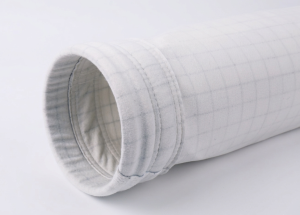
Anti static dust bags are used where dry powder movement, fine dust loading and poor charge dissipation may increase electrostatic risk inside a dust collection system. The correct media construction should be selected based on the dust type, operating temperature, surface resistance target, grounding continuity and overall plant safety requirements.
What Surface Resistivity Means in Dust Bags
Surface resistivity and surface electrical resistance are commonly used to describe how easily electrical charge can move across the surface of a material. In dust filtration, the term is often used when evaluating whether a filter media behaves like an insulating material or whether it can support controlled charge dissipation.
Strictly speaking, surface resistivity and surface resistance are not always the same measurement. Surface resistivity is normally expressed in Ω/square, while surface resistance is commonly expressed in Ω. The final value depends heavily on the test method, electrode arrangement, sample conditioning, humidity and measurement procedure.
For engineering selection, the practical point is this: ordinary polyester needlefelt is generally insulating. When fine dust particles pass across the media surface, impact the fibres, rub against the felt or detach during pulse cleaning, charge can accumulate. If that charge cannot dissipate, the filter bag surface may become a static charge reservoir.
In combustible dust environments, that is a serious concern. A filter bag with suitable antistatic construction helps provide a lower resistance pathway for electrostatic charge to move away from the dust loaded surface and into the grounded collector structure.
Why Static Charge Builds Up in Dust Collection Systems
Static charge in dust collection systems is usually generated by particle movement, friction, separation and impact. As powder travels through ducting, enters the collector body, strikes baffles, moves across filter media and releases during pulse cleaning, charge separation can occur.
This is common in dry processes where dust is fine, airborne, non conductive and present in high concentration. The risk increases when the dust has low moisture content, when the air stream is dry, when plastic or polymer based materials are used, or when there is poor electrical continuity between system components.
| Industry Sector | Common Combustible Dust Types | Why Anti Static Media May Be Required |
|---|---|---|
| Food Processing | Flour, sugar, starch, cocoa, milk powder, grain dust | Fine organic powders can generate static charge during conveying, collection and pulse cleaning |
| Chemical & Plastics | PVC, PE, PP, chemical powders, pigments | Dry polymer and chemical powders may be non conductive and prone to charge accumulation |
| Pharmaceutical | APIs, excipients, tablet production powders | Fine powder handling often requires tighter control of contamination, static and process risk |
| Heavy Industry & Energy | Coal, carbon black, biomass, wood dust, fine metal powders | High dust loading and combustible particulate risks require careful ignition source control |
| Powder Coating & Fine Pigments | Coating powders, pigments, toner like dusts | Fine dry particles can remain airborne and accumulate charge on filter media surfaces |
In these applications, antistatic dust bags are specified because the dust collector is not simply filtering nuisance dust. It is operating in an environment where combustible dust, oxygen, confinement and ignition sources may exist at the same time.
How Conductive Fibres Make Filter Media Antistatic
The technical value of anti static dust bags lies in the conductive pathway built into the media.
In a standard polyester dust bag, the fibres and scrim are typically non conductive. The media can capture dust effectively, but it does not provide a reliable path for static charge dissipation. Antistatic media changes this behaviour by introducing conductive elements into the felt, scrim, yarn or sewn construction.
These conductive elements may include:
• Stainless steel fibres blended into the media
• Stainless steel conductive yarn incorporated into the scrim
• Copper fibres spun or interlaced into conductive yarn
• Carbon fibre or conductive carbon yarn
• Conductive stripe or grid constructions
• Antistatic sewing thread or grounding features
• Hybrid constructions combining conductive yarn with PTFE membrane lamination
When stainless steel or copper fibres are spun together with polyester fibre into a conductive yarn, the resulting media contains a distributed conductive network. Instead of relying on a single wire or isolated contact point, the conductive fibre structure allows charge to move through multiple contact paths within the fabric.
This matters because dust bags flex, pulse, load with dust cake and operate under continuous air movement. A conductive yarn or blended fibre network offers more consistent charge dissipation than a purely surface applied treatment that may wear away, become contaminated or lose effectiveness over time.
Stainless Steel Fibre, Copper Fibre and Conductive Yarn Construction
Stainless steel and copper are used because they are electrically conductive materials that can help reduce media resistance when properly incorporated into the filter structure.
In a stainless steel conductive yarn construction, fine stainless steel fibres or filaments are combined with the base fibre system so the yarn becomes conductive. This yarn can then be incorporated into the scrim or filter fabric structure. The scrim acts as the mechanical backbone of the needlefelt, so placing conductive yarn within the scrim helps create internal electrical continuity across the filter media.
Copper fibre can perform a similar role, providing conductive pathways within the yarn or media structure. Copper offers strong electrical conductivity, while stainless steel provides good mechanical durability and corrosion resistance in many industrial environments. The final choice depends on dust type, temperature, chemical exposure, moisture, abrasion and customer specification.
A properly engineered antistatic construction should not depend only on random metallic fibres scattered through the felt. The conductive system must be positioned so that charge can transfer from the dust loaded surface through the media and into the supporting cage, snap band, tube sheet, housing and earth connection.
This is why the filter bag, cage, tube sheet, dust collector body, ducting, rotary valve, fan section and grounding system must be treated as one connected safety chain.
Why PTFE Membrane Does Not Automatically Mean Antistatic
PTFE membrane laminated dust bags are often used for improved surface filtration, lower dust penetration, better dust cake release and more stable differential pressure behaviour. In many fine dust applications, PTFE membrane is an excellent filtration upgrade.
However, PTFE membrane alone does not automatically make a dust bag antistatic.
A PTFE membrane improves how dust is captured and released at the surface, but antistatic performance depends on whether the underlying media contains conductive fibres, conductive scrim, antistatic yarn or another engineered charge dissipation pathway.
This distinction is important. A plant may specify PTFE membrane because it wants better emission control and dust release. Another plant may specify antistatic construction because it needs static charge control. In higher risk powder applications, both may be required.
A suitable construction may therefore combine polyester needlefelt, stainless steel conductive yarn, antistatic scrim and PTFE membrane lamination. This allows the media to support surface filtration while also helping dissipate electrostatic charge when installed correctly in a grounded dust collection system.
Custom Antistatic DFX™ Constructions
FiltraCore Asia’s DFX-ANT™ range is designed for applications where antistatic dust filtration is required. However, real plant conditions are rarely solved by a single generic media.
A food plant handling flour dust may require polyester based antistatic media with PTFE membrane for dust cake release. A chemical plant may require antistatic media with improved chemical resistance. A plastics facility may require conductive media for resin dust. A high temperature process may need antistatic treatment considered together with fibre temperature limits, gas chemistry and baghouse design.
This is why FiltraCore Asia can support customised antistatic dust bag constructions across selected DFX™ media platforms where technically appropriate.
FiltraCore Asia manufactures and supplies DFX-ANT™ Antistatic Dust Filter Bags for static sensitive and combustible dust applications. We can also customise selected DFX™ dust bag constructions, including DFX-PE™, DFX-PTFE™ and other application specific media, with conductive fibres, antistatic scrim, stainless steel yarn, copper fibre, carbon fibre, conductive grid or PTFE membrane finishing where technically suitable.
Examples include:
• DFX-ANT™ Antistatic Dust Filter Bags for static sensitive dust collection applications
• DFX-PE™ Polyester Dust Filter Bags customised with conductive antistatic construction
• DFX-PE-ENV™ envelope type antistatic polyester dust bags for compatible collector designs
• DFX-PTFE™ or PTFE membrane laminated variants where high filtration efficiency and dust cake release are required
• Application specific conductive yarn, stainless steel fibre, copper fibre, carbon fibre or antistatic scrim options
The correct specification should be based on dust explosibility, operating temperature, moisture exposure, chemical conditions, air to cloth ratio, cleaning system, bag dimensions, cage contact, grounding arrangement and regulatory expectations.
Surface Resistance Values Must Be Interpreted Correctly
Surface electrical resistance values are useful, but they must never be read in isolation.
A value such as 10⁴ to 10⁵ Ω may indicate a highly conductive antistatic construction under controlled test conditions. Other antistatic products may be specified against broader resistance thresholds depending on the test standard, media design and application requirement.
However, the measured value can be affected by:
• Test method and electrode configuration
• Sample conditioning and humidity
• Dust loading and contamination
• Membrane condition and surface wear
• Fibre distribution and conductive yarn placement
• Sewing construction and bag finishing
• Cage contact and snap band seating
• Tube sheet continuity
• Grounding and bonding quality
• Long term mechanical wear in service
Engineering Note: Surface electrical resistance values such as 10⁴ to 10⁵ Ω should not be treated as a stand alone safety guarantee. The value is only meaningful when the conductive pathway remains continuous from the filter media to the cage, tube sheet, dust collector body and earth ground. Dust build up, humidity, media wear, poor cage contact, damaged snap bands or weak grounding continuity can all affect actual charge dissipation in service.
For this reason, a surface resistance figure should be treated as part of the specification, not the whole safety case. In combustible dust systems, antistatic media must be matched with correct installation, verified grounding, suitable explosion protection and site specific risk assessment.
How Antistatic Bags Support ATEX Related Risk Reduction
ATEX related dust filtration applications require careful control of ignition sources in potentially explosive atmospheres. Electrostatic discharge is one possible ignition source, especially when combustible dust is dispersed in air inside enclosed equipment.
Antistatic dust bags support risk reduction by helping dissipate electrostatic charge from the filter media into the grounded collector structure. This reduces the likelihood that charge will accumulate on the filter surface and discharge as a spark under suitable conditions.
However, no filter bag should be described as making a dust collector ATEX compliant by itself.
A dust bag is one component within a larger safety system. Full ATEX related compliance or combustible dust safety depends on the complete equipment design, hazardous area classification, ignition source assessment, explosion venting, explosion isolation, suppression system, spark detection, grounding and bonding, housekeeping, maintenance discipline and site operating procedures.
The correct position is clear: antistatic dust bags can support ATEX related risk reduction when correctly specified and installed within a properly designed, grounded and protected dust collection system.
Practical Selection Checklist for Engineers and Procurement Teams
Before specifying antistatic dust bags, plant engineers and procurement teams should confirm the following:
• Dust type and explosibility characteristics
• Particle size distribution and dust loading
• Operating temperature and peak temperature
• Moisture, condensation and dew point exposure
• Gas chemistry and chemical compatibility
• Baghouse type and cleaning system
• Required bag shape, diameter, length and top or bottom construction
• Tube type, envelope type or custom bag geometry
• Cage material, cage condition and cage contact
• Tube sheet continuity and sealing condition
• Required surface resistance or surface electrical resistance target
• PTFE membrane requirement for surface filtration
• Food contact requirement, if applicable
• ATEX, IECEx, NFPA or local combustible dust framework applicable to the site
• Grounding and bonding verification responsibility
• Explosion venting, isolation or suppression requirements
This checklist protects both the buyer and the supplier. It ensures the filter bag is not selected only by price, temperature rating or fibre name, but by actual operating risk.
Where FiltraCore Asia Fits
FiltraCore Asia supports industrial plants across Asia-Pacific, the Middle East, South Asia and Australia/New Zealand with engineered dust filtration solutions for demanding process environments.
Our DFX™ Dust Filtration Excellence range includes standard and application specific dust bags covering polyester, antistatic, acrylic, PPS, aramid, fiberglass, fiberglass blend, P84®, PTFE and PTFE coated media. For combustible dust and static sensitive applications, FiltraCore Asia can recommend DFX-ANT™ Antistatic Dust Filter Bags or customise selected DFX™ dust bag constructions with conductive antistatic media, stainless steel yarn, copper fibre, carbon fibre, conductive scrim and PTFE membrane options where suitable.
This allows customers to align filtration performance with plant safety, process reliability and procurement practicality.
Speak to FiltraCore Asia About Anti Static Dust Bags
If your plant handles combustible dust, fine powder or static sensitive material, do not select dust bags based on media name alone.
Send FiltraCore Asia your dust type, operating temperature, baghouse design, bag dimensions, cleaning system, current media, required surface resistance target and any ATEX, IECEx, NFPA or site safety requirement. Our team will review the application and recommend a suitable DFX™ dust bag construction, including DFX-ANT™ or customised antistatic variants of selected DFX™ media where technically appropriate.
For anti static dust bags, conductive fibre media, PTFE membrane laminated dust bags or customised DFX™ dust filtration solutions, contact FiltraCore Asia at sales@filtracoreasia.com or visit www.filtracoreasia.com.
FiltraCore Asia. Engineered filtration for safer, cleaner and more reliable industrial operations.