
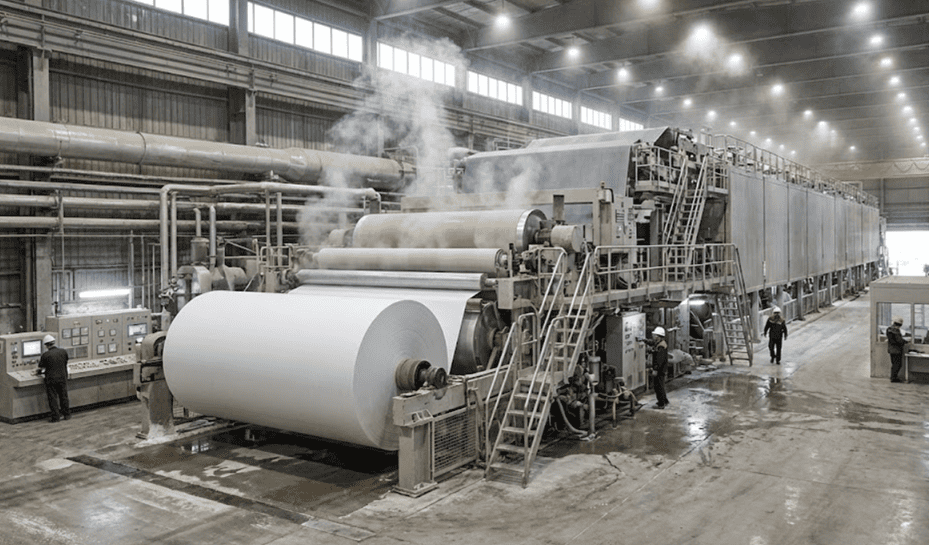
Papermaking Water Filtration: Ensuring Process Stability, Quality, and Efficiency Across Modern Paper Mills
By FiltraCore Asia — Technical Insights SeriesPapermaking water filtration remains the defining element of the global papermaking industry. Despite advances in automation, process chemistry, and fibre optimisation, every paper mill still depends on large volumes of clean, well-conditioned process water. From pulping and stock preparation to wire section formation, pressing, drying, coating, and finishing, papermaking water filtration directly determines runnability, sheet formation, chemical dosing efficiency, equipment cleanliness, and final product quality.
In today’s paper and tissue mills, rising pressure on resource efficiency, chemical optimisation, cost control, environmental compliance, and sustainability has made papermaking water filtration an essential infrastructure component rather than an optional upgrade. Mills that fail to manage suspended solids, fines, colloids, pitch, stickies, biological load, or dissolved substances face higher downtime, sheet breaks, chemical wastage, and declining product consistency.
This guide provides a clear and technically accurate overview of why water filtration matters in modern papermaking processes, the common contaminants mills must manage, the filtration systems used, and how FiltraCore Asia’s LFX™ Series and HFX™ Series support stable, predictable process water performance across paper and tissue operations.
Why Papermaking Water Filtration Determines Process Stability
Papermaking requires water for fibre separation, dilution, washing, chemical transport, heat exchange, cleaning, lubrication, and general process control. Because the pulp suspension is typically less than 1% solids at the forming section, even minor shifts in water quality can influence fibre bonding, drainage rates, felt performance, retention chemistry, sheet formation, and equipment cleanliness.
Modern mills operate under closed-loop or semi-closed water systems, meaning contaminants concentrate over time unless properly removed. Inadequate water management leads to:
– increased deposits (pitch, stickies, slime)
– sheet defects and formation instability
– felt contamination and reduced permeability
– higher microbiological growth
– inefficient chemical reactions
– excessive bleaching agent consumption
– shortened equipment life
Reliable filtration helps maintain stable white water circuits, protect heat exchangers, reduce wear, and improve overall yield.
Common Contaminants Managed by Papermaking Water Filtration Systems
Although water quality varies widely by mill, furnish, coating recipes, and closure level, common contaminants include suspended fibres, fines, fillers, pigments, stickies, pitch, dissolved solids, and microbial load. Carry-over solids influence drainage and retention, while colloidal particles and micelle-bound impurities affect sheet brightness, opacity, surface quality, and chemical consumption. As water recirculates, these contaminants enrich the system, increasing the probability of deposits, odor formation, and system instability.
Effective filtration removes these contaminants at appropriate points — white water loops, showers, seal water lines, coating kitchens, starch systems, chemical feed lines, and machine approach flows — helping mills regain control of process stability.
Key Filtration Stages in Papermaking
Throughout a typical paper mill, multiple water streams require dedicated filtration. Raw water pretreatment protects downstream processes from sand, silt, organics, and microbial contamination. Clarified water sent to stock preparation must be sufficiently clean to avoid interference with fibre swelling, refining, and chemical addition. Machine white water demands continuous conditioning to avoid solids overloading and drainage imbalance.
Spray showers, fan pump feeds, coating circuits, and sizing presses rely on stable, low-turbidity water to prevent nozzle blockages and sheet surface defects. Effluent treatment systems — which handle dissolved organics, residual fibres, and suspended solids — also depend on robust filtration to meet regulatory discharge requirements.
These process points require housings and filter elements that can withstand flow variations, continuous operation, variable solids loading, chemical exposure, and temperature shifts.
Papermaking Water Filtration Solutions Used in Modern Mills
Modern mills use a combination of depth filters, pleated cartridges, bag filters, strainers, and high-flow systems to stabilise their water loops. Depth filtration is commonly implemented for high-load streams where suspended solids and fibre fragments require removal without rapid clogging. Pleated cartridges with larger surface area support stable pressure drop and polishing performance in coating and finishing applications. Fibre removal and chemical purity management rely on high-flow housings capable of maintaining laminar behaviour, preventing media deformation, and ensuring predictable flow patterns.
FiltraCore Asia’s filtration technologies support each of these requirements. The LFX™ Series provides engineered solutions for high-loading prefiltration, polishing, and chemical stability. The HFX™ stainless steel and thermoplastic housings offer the structural integrity, sealing performance, chemical compatibility, and durability that mills require for continuous operation.
FiltraCore Asia’s LFX™ Filter Bags and Cartridges for Papermaking
The LFX™ lineup delivers stable, predictable filtration performance across key stages in papermaking:
• Melt-blown polypropylene cartridges (LFX-CMB™) for high-loading circuits
• Pleated polypropylene cartridges (LFX-CPLEAT-PP™) for coating, finishing, and chemical systems
• Carbon block and GAC cartridges (LFX-CACT™) for organic removal and odour control
• Big-blue high-flow cartridges (LFX-CBIG™) for machine-side water streams
• PP and PE liquid filter bags (LFX-PP™, LFX-PE™) for general filtration and solids reduction
• Nylon monofilament bags (LFX-NMO™) for oversized particle or contaminant removal
• PTFE filter bags (LFX-PTFE™) for corrosive or chemical-sensitive applications
These solutions help reduce solids loading, stabilise chemistry, extend felt lifetimes, reduce nozzle blockages, and improve overall machine efficiency.
FiltraCore Asia’s HFX™ Filter Housings for Mill Water Systems
The HFX™ Series provides industrial-grade housings designed for continuous duty. Stainless steel housings support high-pressure, hygienic, and high-temperature applications, while thermoplastic housings are suited for corrosive circuits and cost-sensitive areas. Multi-cartridge and high-flow housings support large volumes, while single-cartridge systems provide precision filtration at critical points.
For mills aiming to reduce maintenance and downtime, self-cleaning housings — including scraping, backwash, and automated filtration systems — will soon form part of FiltraCore Asia’s housing technology expansion.
How Papermaking Mills Benefit from Proper Filtration
When water quality is stabilised, mills experience measurable improvements in machine performance, output consistency, and operating cost efficiency. Cleaner water contributes to smoother sheet formation, reduced sheet breaks, lower chemical consumption, stabilised coating performance, extended felt lifetime, and improved heat-exchanger efficiency. Mills also gain stronger environmental compliance performance, reduced wastewater load, and more predictable maintenance planning.
Conclusion: Water Filtration Determines Papermaking Performance
In modern papermaking, water is both a vehicle and a variable. Mills that manage water quality effectively achieve more stable operations, higher output consistency, lower chemical wastage, reduced fouling, and more predictable maintenance cycles. FiltraCore Asia’s LFX™ and HFX™ solutions provide the technical foundation required to maintain stable, reliable process water across pulping, preparation, formation, pressing, drying, coating, and finishing stages.
By combining advanced media technologies, precision housings, and application-specific engineering, FiltraCore Asia supports mills across Asia in building more efficient, reliable, and compliant water management systems.
For an in-depth technical overview of how pulp and paper mill effluent is treated — including biological, physical and chemical methods relevant to water filtration systems — readers can refer to the comprehensive review “The treatment of pulp and paper mill effluent” published on ScienceDirect.