Industrial Dust Filter Bags: Complete Technical Guide
Introduction: Why Industrial Dust Filter Bags Still Matter in 2025 and beyond
Across cement plants, steel mills, biomass boilers, chemical processing facilities and waste-to-energy plants, the long-term performance of a baghouse still depends on the quality and stability of its dust filter bags. In 2025, environmental regulations across Asia have tightened, driving industries to reduce particulate emissions, maintain predictable system uptime and avoid unplanned maintenance shutdowns.
Even as automation and sensor-based monitoring improve control over dust collection systems, the dust filter bag remains the primary filtration surface. Without a correctly engineered bag, even the best pulse-jet controller, ID fan or hopper system will fail to deliver stable performance. This guide provides a technically accurate and practical overview of modern industrial dust filter bags, material technologies and application-specific considerations, with direct references to FiltraCore Asia’s DFX™ series and how these products support today’s industrial requirements.
Advanced Media Technologies and Emission Compliance
Tightening environmental standards have accelerated the shift toward advanced media technologies. Surface-treated felts, PTFE membranes, multi-layer structures and reinforced scrims enable facilities to lower emissions without excessive cleaning demand. Modern baghouse monitoring tools now track differential pressure, cleaning cycles and bag performance in real time, reinforcing the importance of selecting stable filtration media from the start.
FiltraCore Asia integrates these advances into the DFX™ series, offering predictable compliance support and operational stability.
The Role of Dust Filter Bags in Modern Baghouses
A dust filter bag functions as both a mechanical barrier and a dynamic filtration layer. When first installed, the felt or woven media captures particulate matter through mechanical separation. As operation continues, the formation of a stable dust cake enhances filtration efficiency and reduces emissions.
This process only works when material selection, fibre structure, permeability and finishing treatments match the system’s characteristics, including gas temperature, chemistry, particulate behaviour and cleaning mechanism. In Asia, pulse-jet baghouses dominate heavy industry due to compact footprint and effective cleaning, while reverse-air systems remain in use in selected boilers, incineration plants and older chemical facilities. Each system requires the appropriate bag design, top and bottom construction and media durability.
Key Materials Used in Industrial Dust Filtration
Modern industrial dust bags rely on engineered fibres with predictable performance under heat, moisture and chemical exposure. Polyester remains a widely used general-purpose option for woodworking, grain processing and low-temperature dust systems. Polypropylene provides excellent resistance in corrosive or acidic environments.
Homopolymer acrylic needlefelt performs reliably in low-to-medium temperature systems exposed to acidic or moisture-laden gas streams. Aramid (Nomex®) supports higher temperatures in cement preheater lines and asphalt mixing. PPS (Ryton®) is the industry standard for coal-fired boilers, fluidised bed combustors and systems exposed to acidic condensates. P84® polyimide, with its tri-lobed fibre structure, offers enhanced surface area, reduced emissions and lower pressure drop. PTFE, in laminated or pure felt form, provides the highest chemical and thermal resistance for the most demanding industrial environments.
Modern industrial dust filter bags rely on engineered fibres designed to withstand heat, moisture and chemical attack:
- Polyester A cost-efficient, general-purpose option for low-temperature dust systems.
- Polypropylene Excellent for corrosive environments and acid-mist handling.
- Acrylic Homopolymer acrylic needlefelt is ideal for moisture-rich or acidic flue gases.
- Aramid (Nomex®) A high-temperature material commonly used in cement preheaters and asphalt plants.
- PPS (Ryton®) Outstanding chemical resistance; widely used in coal, biomass and CFB boilers.
- P84® Polyimide Tri-lobed fibre design improves surface filtration, lowers emissions and reduces differential pressure.
- PTFE The premium option for the harshest chemical, corrosive and high-temperature conditions.
Temperature and Chemical Considerations in Dust Filtration
Temperature is the most critical factor when selecting a dust bag. Exceeding recommended temperatures causes shrinkage, hardening, embrittlement or glazing, all of which increase differential pressure and reduce bag life. Chemical exposure must also be evaluated carefully. Acidic vapours such as SOx, NOx and HCl accelerate fibre degradation, particularly when moisture triggers acid dewpoint corrosion.
Homopolymer acrylic and PPS solutions are typically selected for corrosive applications, while P84® and PTFE offer stability when both temperature and chemistry are demanding. The DFX™ product range covers the full spectrum of industrial operating conditions, allowing engineers to match each process to the most suitable filtration media.
Air-to-Cloth Ratio and System Performance
The reliability of a baghouse is strongly influenced by its air-to-cloth (A/C) ratio. High airflow with insufficient filter area results in aggressive cleaning cycles, unstable dust cake formation and early bag failure. Conservative A/C ratios stabilise emissions and extend bag life.
Proper sizing considers dust characteristics, gas temperature, inlet loading, cleaning method, bag geometry and pressure drop expectations. FiltraCore Asia follows industry-validated A/C ratio guidelines for sectors such as cement, power generation, steelmaking, biomass and incineration. These guidelines ensure that DFX™ bags operate within optimal mechanical loading limits for stable, predictable performance.
Applications Across Major Industrial Sectors
Industrial dust filter bags support a broad range of applications, each with distinct temperature, chemistry and particulate challenges. In cement plants, high-temperature and alkali-resistant materials such as DFX-NMX™ and DFX-P84™ are typically required for kiln, clinker cooler and preheater lines. Power generation relies on PPS due to acidic flue gas and strict emission limits.
Steelmaking, sintering and foundry operations require media capable of withstanding hot, abrasive metallic dust. Waste incineration combines corrosive gases with fluctuating moisture, making PTFE or P84® essential for long-term reliability. Biomass boilers produce organic acids and volatile compounds that accelerate fibre degradation, making acid-resistant felts the safer choice. The DFX™ portfolio addresses each scenario through material grades proven across Asia’s industrial base.
DFX™ Industrial Dust Filter Bags by FiltraCore Asia
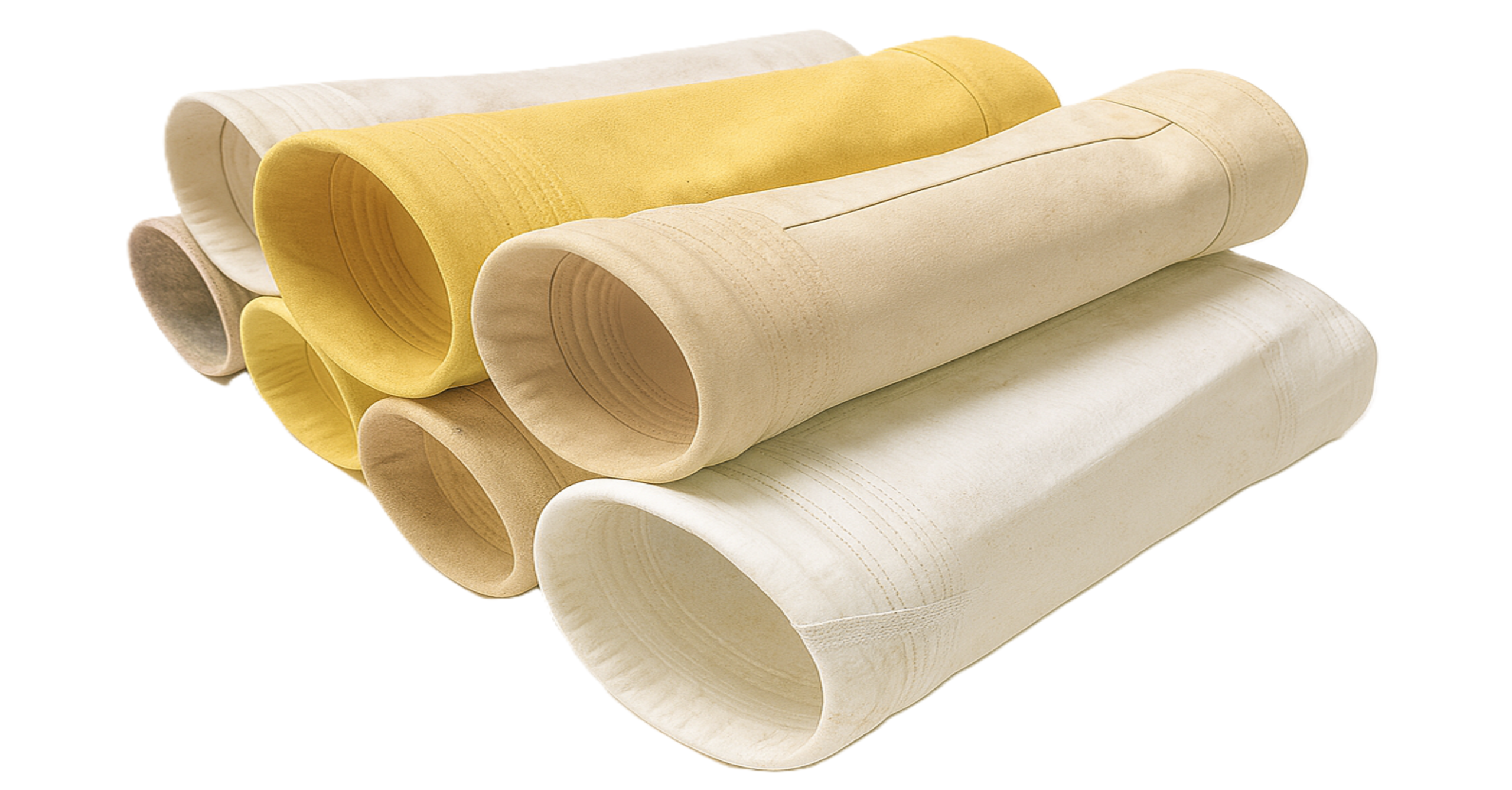
FiltraCore Asia’s DFX™ series unifies filtration expertise with real-world industrial performance. The portfolio includes homopolymer acrylic (DFX-ACR™), polyester (DFX-PES™), anti-static bags (DFX-ANT™), aramid high-temperature bags (DFX-NMX™), PPS (DFX-PPS™), P84® (DFX-P84™), FMS-reinforced media (DFX-FMS™) and PTFE (DFX-PTFE™). Each product is engineered for predictable behaviour in both pulse-jet and reverse-air systems, with controlled fibre weight, optimised permeability, reinforced scrim structure and industry-aligned finishes.
All DFX™ products are fully compatible with the region’s leading OEM baghouse designs in cement, power generation, steel, chemicals, waste incineration, food production and biomass processing.
Why FiltraCore Asia Leads in Industrial Dust Filtration
FiltraCore Asia delivers filtration solutions aligned with global engineering standards. The DFX™ series combines high-performance media, precise manufacturing, consistent quality control and full OEM compatibility. Whether the objective is extending bag life, lowering pressure drop, upgrading a baghouse or selecting the correct material for a new process, FiltraCore Asia provides solutions built for reliability and compliance in modern industrial environments.
Conclusion: The Future of Dust Filtration in Asia
As industries modernise and environmental expectations grow, engineered dust filtration solutions will become even more essential. The industrial dust filter bag remains a critical component for maintaining safe, clean and compliant operations. FiltraCore Asia’s DFX™ series provides a complete, technically robust filtration platform for facilities seeking stable performance, reduced emissions and predictable maintenance across Asia-Pacific and beyond.