
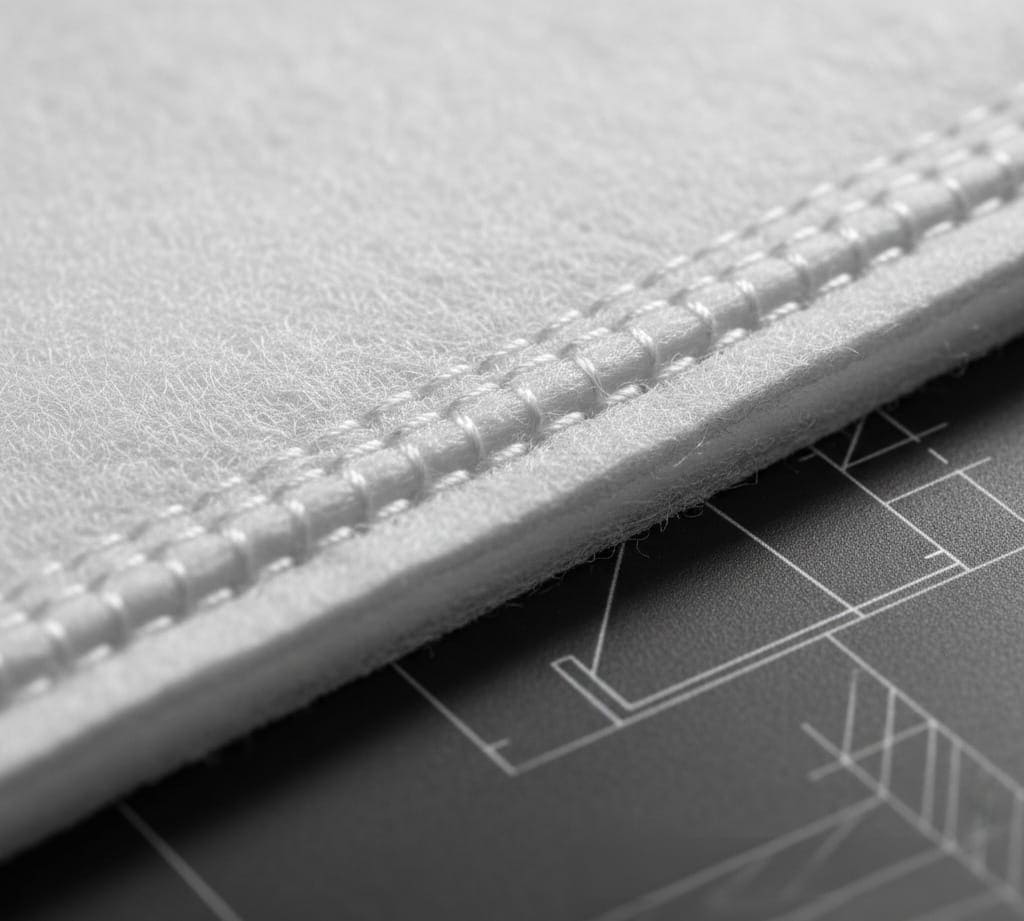
Why seam engineering dictates filtration integrity and operational risk
By FiltraCore Asia — Technical Insights Series
Liquid filter bag stitching is one of the most critical — and most frequently overlooked — engineering elements in industrial liquid filtration systems. Yet across real operating environments, a recurring pattern emerges: a significant proportion of so-called “media failures” originate not in the media itself, but at the seam.
From an engineering perspective, a liquid filter bag behaves as a deformable pressure vessel. As differential pressure (ΔP) rises, the bag expands and distorts, transferring circumferential load (hoop stress) to the stitched seam. When stitching is treated as a basic sewing operation rather than an engineered joint, it becomes the most likely point of bypass leakage, media migration, and premature filtration failure.
This article examines liquid filter bag stitching as a structural, hydraulic, and cleanliness-critical system — explaining how stitched seams function, how they fail, and how disciplined seam engineering materially reduces operational risk.
The Triad of Liquid Filter Bag Stitching Functions
A high-integrity stitched seam must perform three simultaneous engineering functions under load:
1. Mechanical Load Transfer
As the filter bag inflates under ΔP, the seam must distribute hoop stress evenly across the joint without concentrating tensile forces at discrete needle perforations.
2. Hydraulic Boundary Integrity
The seam must maintain a continuous hydraulic seal, preventing bypass channels from forming as pressure fluctuates during pump start-up, valve actuation, or viscosity changes.
3. Morphological Stability
Needle penetrations must not evolve into sites of media migration (also referred to as fibre shedding), where disrupted felt structure allows fibres or fine solids to escape into the filtrate.
A stitched seam that fails any one of these functions compromises the entire filtration system, even if the filter media remains intact.
Why Liquid Filter Bag Stitching Quality Matters More Than Most Buyers Realise
In practice, many filtration problems attributed to incorrect micron rating or media selection can be traced back to inadequate liquid filter bag stitching. Seam-related issues rarely present as immediate ruptures. Instead, they appear as subtle, progressive symptoms:
Downstream haze or fines despite intact media
Unstable or rapidly rising differential pressure
Inconsistent batch quality
Premature bag distortion or collapse
Because these symptoms develop gradually, the seam is often overlooked during root-cause analysis.
“Sewn” Is Not a Specification
One of the most common procurement errors is treating “sewn seam” as a binary attribute. In reality, liquid filter bag stitching exists on a wide quality spectrum, governed by stitch geometry, thread selection, stitch density, and execution control.
Two bags described identically on paper may perform very differently in service due to differences in seam engineering alone.
Common Liquid Filter Bag Stitching Types Used in Industrial Filtration
The most frequently encountered stitched seam constructions are summarised below.
Stitch Construction Comparison (Engineering Perspective)
| Stitch Type | Construction Description | Stress Distribution | Bypass Risk | Typical Application Tier |
|---|---|---|---|---|
| Overlock / Serged | Single-pass edge wrap | Poor (edge-concentrated) | High | Commodity |
| Single-Needle Lockstitch | Basic interlocking stitch | Moderate | Moderate | Entry industrial |
| Double-Needle Lockstitch | Parallel structural stitch rows | Evenly distributed | Low–Moderate | Engineered sewn |
| Sewn + Seam Tape Overlay | Stitching with bonded seal | Even + sealed | Low | Premium |
This comparison illustrates why liquid filter bag stitching must be evaluated as an engineered system, not a manufacturing detail.
Overlock / Serged Stitching: Commodity Construction
Overlock stitching is common in low-cost filter bags.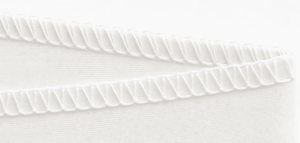
Engineering characteristics
Single looping thread around the edge
Wide stitch pitch
High needle hole exposure
Failure behaviour
Seam “unzipping” under pressure surges
Accelerated media migration
Early bypass during transient flow events
Overlock construction represents the lowest tier of liquid filter bag stitching and is unsuitable for applications where filtration reliability matters.
Double-Needle Lockstitch: Engineered Stitching
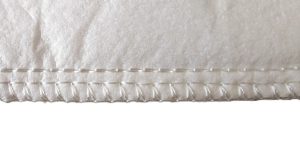
Double-needle lockstitching marks a transition from basic fabrication to engineered seam construction.
Engineering characteristics
Parallel stitch rows
Controlled stitch pitch
Improved dimensional stability
Engineering implications
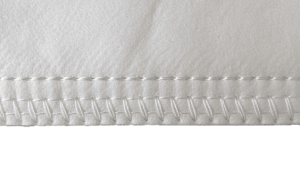
Seam strength approaches or exceeds parent media
Better
tolerance of pressure cycling
Reduced seam distortion under load
When properly executed, this construction represents a robust standard for liquid filter bag stitching in general industrial liquid filtration.
The Needle Hole Paradox: Stitch Density vs Seam Integrity
A common misconception is that higher stitch density automatically produces a stronger seam. In reality, excessive stitching introduces a perforation effect, weakening the felt structure much like a postage stamp edge.
Under-stitching allows seam “yawning” under pressure pulses, creating bypass paths.
Over-stitching damages the felt matrix, lowering tear resistance and accelerating failure.
Proper stitch density is a critical design variable in reliable liquid filter bag stitching and must be matched to media GSM and mechanical behaviour.
Thread Selection: The Chemical and Thermal Variable
Thread is frequently the silent failure point in stitched filter bags.
Failure mechanisms include:
Chemical embrittlement from incompatible fluids
Differential swelling, enlarging needle holes
Loss of tensile strength during thermal cycling
Thread failure is one of the most common hidden causes of liquid filter bag stitching breakdown in the field.
Pressure Surges: Where Poor Stitching Fails First
Most seam failures occur during non-steady-state conditions:
Pump start-up
Valve transitions
Cold-start viscosity spikes
Pressure transients are where poorly designed liquid filter bag stitching fails first, as load concentrates at needle perforations faster than the seam can redistribute stress.
Seam Tape / Global Bond Overlays (Advanced Practice)
Some high-end manufacturers apply a thermoplastic seam tape over stitched seams.
Purpose
Seal needle perforations
Reduce bypass risk
Improve cleanliness without relying on fusion
When applied with process control, seam tape overlays enhance liquid filter bag stitching performance. Poorly applied, they offer little benefit.
Why Not Just Weld Everything?
Ultrasonic welding is a valid seam technology for thermoplastic media and will be addressed separately. However, engineered stitching remains relevant — and often preferred — for:
Thick or high-GSM felts
High-viscosity liquids (oils, resins, adhesives)
Heavy-duty industrial service
Applications involving repeated handling or mechanical abuse
This is why liquid filter bag stitching continues to be specified in demanding applications despite advances in welding technology.
How FiltraCore Asia Applies Seam Engineering Discipline
Across its liquid filtration portfolio, FiltraCore Asia applies the same governance-led engineering principles to seam construction. Workhorse examples such as LFX-PP™, LFX-PE™, and LFX-NMO™ are referenced here because they represent common industrial formats — not because they are exceptions.
This approach reflects:
Controlled stitch execution aligned to media behaviour
Polymer-matched thread selection
QA-led inspection and traceability
Japanese Kodawari attention to workmanship
Singapore-based governance and accountability
FiltraCore Asia positions itself as an engineering partner — not a supply-and-forget vendor.
Engineering Conclusion: Seams Are Not Consumables
In liquid filtration, stitching is the weakest link only when it is poorly engineered.
Treating filter bags as commodities exposes processes to avoidable risk. By specifying engineered seams, operators reduce total filtration cost, improve process stability, and prevent downstream contamination events.
For readers who want a broader engineering foundation on how bag filter systems operate, ScienceDirect’s topic page on bag filters provides a structured overview of design principles, media selection, flow behavior, and performance considerations across industrial applications. This external resource helps frame how media properties, housing configuration, and seam or joint design affect filtration efficiency, pressure drop, and long-term reliability — reinforcing the importance of evaluating liquid filter bag stitching as part of an integrated filtration system rather than an isolated attribute.
A 1% bypass through a poorly stitched seam can reduce a 5-micron filter’s efficiency to that of a 25-micron filter. Don’t let a thread ruin your process integrity. Contact FiltraCore Asia for a Seam Integrity Analysis or to evaluate our LFX™ engineered liquid filter bag range, designed with disciplined stitching standards and QA control.