Dust Collection and Environmental Emissions Control: Engineering Discipline for Industrial Safety and Compliance
By FiltraCore Asia — Technical Insights Series
Dust Collection and Environmental Emissions Control – Why Dust Collection Is Core Process Engineering
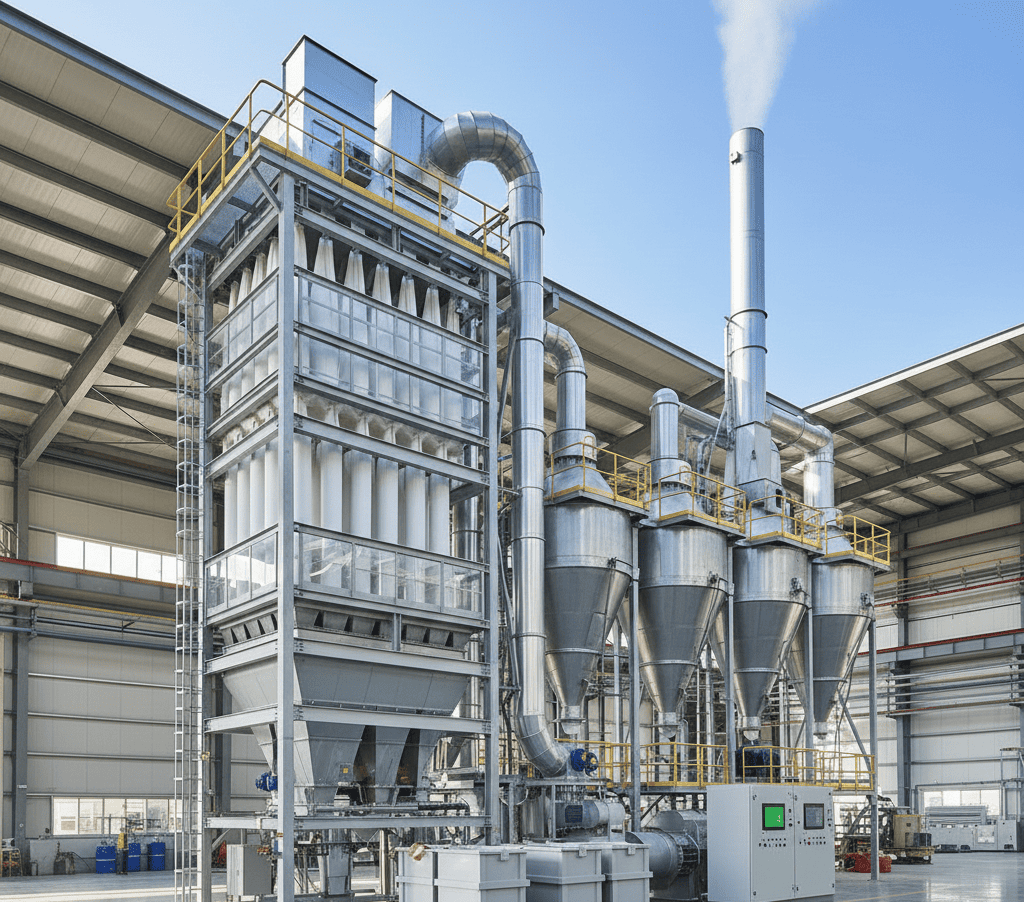
Dust collection and environmental emissions control are not secondary EHS add-ons. In modern industrial plants, they are core engineering systems that directly affect safety, regulatory compliance, equipment reliability, and process stability.
Industries handling powders, bulk solids, minerals, biomass, chemicals, food ingredients, or combustion by-products generate airborne particulates at nearly every transfer, discharge, or agitation point. Without engineered capture and filtration, these particulates migrate into workspaces, utilities, rotating equipment, and the surrounding environment—driving exposure risks, accelerated wear, non-compliance, and in extreme cases, fire or explosion events.
Effective dust control therefore demands the same engineering rigor applied to reactors, pumps, or heat exchangers. It is a system-design problem governed by airflow physics, filtration mechanics, and safety logic—not a procurement exercise.
Where Industrial Dust Is Generated
Dust generation occurs whenever solid materials are fractured, conveyed, dropped, mixed, or reclaimed. Common sources include crushers, mills, conveyors, silos, bag dump stations, mixers, dryers, screeners, and packaging lines.
Dust characteristics vary widely. Particle size distribution, abrasiveness, moisture affinity, chemical reactivity, and combustibility all influence filtration behaviour. A dust collection system that performs well in one process may fail catastrophically in another if these variables are ignored.
Engineering Objectives of Dust Collection Systems
A properly engineered dust collection system must satisfy multiple, sometimes competing, objectives:
• Control particulate emissions to regulatory limits
• Maintain stable airflow at dust-generation points
• Protect downstream equipment from abrasive wear
• Reduce worker exposure to respirable dust
• Mitigate fire and explosion risk in combustible dust environments
Systems optimised for “lowest pressure drop” often fail these objectives. In practice, predictable and stable differential pressure is far more important than minimal resistance.
Fundamentals of Dust Collection System Design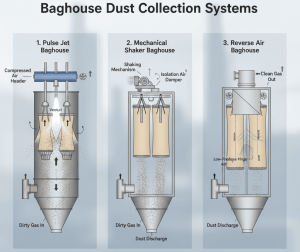
Capture and Conveyance: Getting the Physics Right
Effective dust control begins at the source. Capture hoods and enclosures must generate sufficient capture velocity to entrain dust without disturbing material flow.
Equally critical is duct design. Duct velocity must remain above the minimum transport velocity required to keep particles suspended. If velocity drops too low, dust settles inside ducting, creating blockages, secondary emission points, and internal fire or explosion hazards.
Dust collection failures frequently originate upstream of the filter—long before media selection becomes relevant.
Filtration and Separation: Air-to-Cloth Ratio Matters
Once captured, dust-laden air is directed to filtration equipment—typically baghouses or cartridge collectors—where particles are separated from the gas stream.
Key design variables include:
• Air-to-cloth ratio
• Filter media permeability and structure
• Dust cake formation and release behaviour
• Cleaning mechanism (pulse jet, reverse air, shaker)
• Stable differential pressure
Undersized systems with excessive air-to-cloth ratios experience unstable pressure, poor cleaning, and premature filter failure. Oversized systems increase capital and energy costs without improving performance.
A stable dust cake is not a defect—it is essential for high-efficiency particulate capture, particularly for fine particles.
Filter Cleaning Mechanisms and Media Matching
Different cleaning mechanisms impose very different mechanical stresses on filter media.
Pulse-jet systems subject filter bags to repeated high-energy “snap” forces during cleaning. Media must exhibit dimensional stability and fatigue resistance to survive continuous operation. Reverse-air and shaker systems impose lower instantaneous stress but require media with consistent permeability and structural integrity.
Filter media must therefore be physically matched to the cleaning method, not selected on micron rating alone.
Cleaning and Dust Discharge
Collected dust must be discharged continuously and reliably. Poor hopper geometry, bridging, or leaking discharge devices lead to dust build-up, pressure instability, and re-entrainment.
Rotary valves, screw conveyors, and sealed discharge systems are used to maintain pressure isolation while preventing dust escape back into the system.
Dust Collection and Environmental Emissions Control and Fine Particulates
Regulatory focus is increasingly shifting toward fine particulates, particularly PM10 and PM2.5. These particles remain airborne longer, penetrate deeper into the respiratory system, and are harder to capture.
Compliance today is not only about meeting stack limits during periodic testing, but maintaining consistent filtration performance under real operating conditions. Media selection, cleaning stability, and dust cake control directly affect fine-particle capture efficiency.
Combustible Dust and ATEX Risk: The Dust Explosion Pentagon
Many industrial dusts—including flour, sugar, starch, biomass, coal, aluminium, resin fines, and certain chemicals—are combustible when dispersed in air.
Dust explosions are governed by five elements, often referred to as the Dust Explosion Pentagon:
-
Fuel (combustible dust)
-
Oxygen
-
Dispersion
-
Confinement
-
Ignition source
Dust collectors inherently combine several of these elements, making explosion risk a primary design constraint rather than an afterthought.
Engineering controls typically include:
• Anti-static or conductive filter media
• Grounding and bonding
• Controlled cleaning energy
• Explosion venting or suppression where required
• Isolation between interconnected systems
Without appropriate media and system design, dust collectors can become ignition sources rather than safety controls.
Where FiltraCore Asia Fits
FiltraCore Asia supports industrial operators with dust and air filtration solutions engineered around real operating physics, regulatory pressure, and safety constraints.
Dust Filtration Media — DFX™ Series

DFX™ Dust Filter Bags are designed for continuous-duty industrial dust collection across cement, minerals, chemicals, food, biomass, and power generation.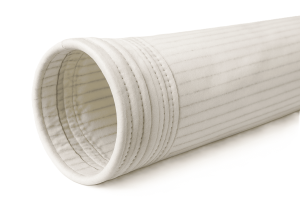
In combustible dust environments, DFX-ANT™ Anti-Static Dust Filter Bags are deployed to dissipate electrostatic charge and reduce ignition probability in ATEX-classified or explosion-sensitive zones. Media selection is aligned with dust properties, operating temperature, and cleaning method—not generic material assumptions.
Mechanical Integrity and Housing Design — HFX™
Filtration performance depends as much on housing design as on media.
HFX™ industrial filter housings support uniform airflow distribution, reliable sealing, stable dust discharge, and predictable cleaning behaviour—critical to maintaining consistent differential pressure and emissions performance over time.
Environmental and Ambient Air Control — AFX™
Even with effective point-source dust co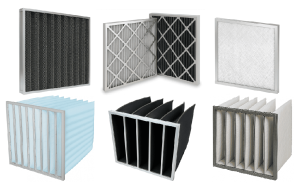 llectors, background airborne dust can migrate into production areas.
AFX™ Air Filtration systems, including pleated panel and pocket filter configurations, are applied in HVAC and ventilation systems to reduce ambient dust levels, protect equipment, and support worker exposure limits.
ATEX-Aligned Design Logic
FiltraCore’s approach to dust filtration in hazardous environments is grounded in risk-aligned engineering, not blanket claims.
This includes:
• Anti-static filtration media where electrostatic risk exists
• Compatibility with grounding and bonding practices
• Stable filtration behaviour to prevent dust accumulation
• Integration with plant-specified explosion protection measures
The objective is to reduce ignition probability and consequence through disciplined filtration design.
Summary: Engineering Reference Table
| Component | Engineering Function | Critical Control Variable | FiltraCore Solution |
|---|---|---|---|
| Pickup Hood | Capture at source | Capture velocity | System design |
| Baghouse | Primary separation | Air-to-cloth ratio / ΔP | DFX™ Series |
| Hopper / Valve | Dust discharge | Seal integrity / no bridging | HFX™ housings |
| Safety Zone | Explosion mitigation | Conductivity / grounding | DFX-ANT™ media |
| HVAC | Ambient dust control | Fine particulate efficiency | AFX™ filters |
Conclusion: Dust Control as Industrial Infrastructure
Dust collection and environmental emissions control sit at the intersection of process engineering, safety management, and regulatory compliance.
Plants that treat dust control as engineering infrastructure—rather than an EHS afterthought—achieve safer operations, lower lifecycle costs, and greater resilience.
FiltraCore Asia supports industrial operators with filtration solutions designed to perform under real operating conditions, where safety, stability, and compliance must coexist.
For readers seeking a deeper technical foundation on dust collection principles, the ScienceDirect topic page on dust collectors provides an authoritative overview of industrial dust separation technologies, filtration mechanisms, and system design considerations. The resource outlines how dust collectors function across different industries, including airflow management, filter media behaviour, and particulate capture efficiency—complementing the engineering-focused discussion in this article on dust collection and environmental emissions control.