
Polymer Filtration Systems: Engineering Control Across Resin and Polymer Production
By FiltraCore Asia — Technical Insights SeriesWhy Polymer Filtration Systems Are Process-Critical
Polymer filtration systems are a fundamental engineering control in resin and polymer production, directly influencing product quality, process stability, and plant uptime. Across polymerisation, compounding, recycling, and finishing operations, filtration is not an auxiliary utility — it is embedded process infrastructure.
Resin and polymer manufacturing environments generate contaminants from multiple sources, including catalyst residues, gels, degraded polymer fragments, additive agglomerates, and mechanical wear debris. Without correctly engineered polymer filtration systems, these contaminants migrate downstream, leading to fouled heat exchangers, blocked dies, inconsistent pellet quality, and elevated scrap rates.
For modern polymer plants operating at scale, filtration must be designed as a staged, load-managed system rather than a reactive corrective measure.
Where Contamination Arises in Resin and Polymer Production
Contamination enters resin and polymer processes through predictable mechanisms.
During polymerisation, fine catalyst residues, reaction by-products, and polymer fines remain suspended in liquid or slurry phases. In compounding and blending operations, fillers, pigments, stabilisers, and performance additives can introduce undispersed solids and soft agglomerates. Thermal stress and shear generate gels and degraded polymer fragments, while pumps, mixers, and transfer systems contribute metallic wear particles.
Utilities further exacerbate contamination risk. Inadequately filtered heating media, inert gas systems, or compressed air can introduce oil aerosols, moisture, and corrosion debris into sensitive processing zones.
Effective polymer filtration systems are engineered around these realities, not idealised clean-feed assumptions.
Core Objectives of Polymer Filtration Systems
Polymer filtration systems are implemented to achieve four primary objectives.
First, product quality control, ensuring gels, catalyst fines, and particulate contaminants are removed before extrusion, pelletising, or finishing stages.
Second, process stability, protecting pumps, static mixers, heat exchangers, and dies from fouling and erosion.
Third, yield protection, reducing off-spec material, rework, and line stoppages caused by contamination-related defects.
Fourth, asset protection, extending equipment life and reducing unplanned maintenance in continuous-duty operations.
These objectives must be achieved without excessive pressure drop, frequent changeouts, or disruption to throughput.
Viscosity and Temperature Effects in Polymer Filtration Systems
In polymer filtration systems, differential pressure behaviour is strongly influenced by fluid viscosity and operating temperature. Resin solutions, polymer melts, and highly loaded process streams require significantly higher energy to move through filtration media compared to low-viscosity fluids.
As viscosity increases, poorly selected filter media can experience rapid pressure rise, localised compaction, or structural deformation. Media selection in polymer filtration systems must therefore account not only for particle retention, but also for the mechanical strength of the filter element under elevated pressure and temperature conditions. Correct selection helps prevent bypass, premature failure, and unstable filtration performance during continuous operation.
Staged Filtration as Best Practice in Polymer Processing
High-performing polymer filtration systems are built around staged filtration architectures, where each stage performs a defined role and protects downstream processes.
Bulk Solids and Catalyst Residue Control
Upstream filtration removes coarse particulates, catalyst residues, and mechanical debris from polymer solutions or process liquids. This stabilises solids loading and prevents premature fouling of downstream fine filtration elements.
Depth filtration is commonly applied at this stage due to its high dirt-holding capacity and predictable pressure behaviour under variable contaminant loads.
Fine Filtration and Gel Management
Secondary filtration stages target finer particulates, soft agglomerates, and gel precursors that impact optical clarity, mechanical performance, and extrusion stability. These stages are critical prior to pelletising, coating, or downstream conversion.
Filtration media selection is governed by polymer chemistry, temperature, viscosity, and contamination profile rather than micron rating alone.
Shear Sensitivity and Gel Formation in Polymer Filtration
In polymer filtration systems, filtration performance is influenced not only by particle retention, but also by the mechanical shear introduced as viscous resin streams pass through filter media. When filtration is overly restrictive, localised pressure and shear can increase across the filter element.
Excessive shear can accelerate thermal degradation, promote polymer chain scission, and in some systems contribute to additional gel formation rather than reducing it. For this reason, polymer filtration systems must be engineered with careful consideration of media permeability, surface area, and structural integrity to ensure contaminants are removed without introducing new degradation mechanisms.
This balance is particularly important in downstream and polishing stages, where contaminant loads are lower but sensitivity to pressure instability and product defects is highest.
Polishing and Equipment Safeguarding
Final filtration stages act as protective safeguards immediately upstream of sensitive equipment. These elements are not intended to manage bulk contamination, but to intercept residual fines and stabilise long production runs.
Polymer Filtration Across Common Production Routes
Polymer filtration systems are applied across a wide range of resin and polymer manufacturing routes.
In solution and slurry polymerisation, filtration removes catalyst fines, polymer debris, and reaction by-products prior to finishing or solvent recovery.
In compounding and additive blending, filtration stabilises formulations by removing undispersed solids and foreign particulates.
In recycling and reprocessing, filtration manages degraded polymer fragments and contamination introduced during feedstock handling.
In utilities and supporting systems, filtration protects heating, cooling, and inert gas circuits from secondary contamination.
Each application demands filtration systems matched to operating temperature, viscosity, chemical compatibility, and solids loading.
Housing Design and System Integrity
Filter housings in polymer filtration systems must withstand demanding operating conditions. Elevated temperatures, variable pressures, and chemically aggressive media are common in resin and polymer plants.
Poor housing design results in bypass leakage, unsafe changeouts, and inconsistent filtration performance. Robust housings with proper sealing, venting, drainage, and pressure rating are essential to ensure filtration elements perform as designed throughout their service life.
Quick Reference: Filtration Selection by Production Stage
| Production Stage | Primary Contaminant | Recommended Media Type | Operational Objective |
|---|---|---|---|
| Polymerisation | Catalyst residues, fines | Depth (Bags / Melt-blown) | Protect downstream equipment |
| Compounding | Pigment agglomerates | Pleated Polypropylene | Uniform colour & texture |
| Recycling | Degraded polymer fragments | Automated Self-Cleaning | Continuous flow under high load |
| Utilities | Pipe scale, oil aerosols | Stainless / Depth | Prevent secondary contamination |
Where FiltraCore Asia Fits
FiltraCore Asia supports resin and polymer producers with application-driven filtration solutions engineered for real plant conditions.
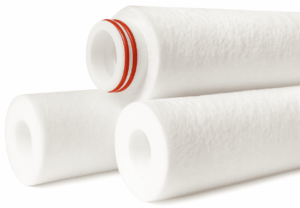
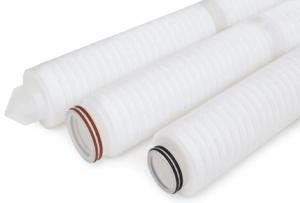
For liquid-phase polymer processing and compounding applications, LFX-CMB™ Melt-Blown Polypropylene Depth Filter Cartridges are applied where high dirt-holding capacity and stable pressure behaviour are required under variable solids loading. Where finer particulate control or surface-defined retention is required, LFX-CPLEAT-PP™ Pleated Polypropylene Filter Cartridges provide predictable polishing performance and consistent service life.
For upstream stabilisation and bulk solids removal, LFX-PP™ Polypropylene Filter Bags and LFX-PE™ Polyester Filter Bags are deployed in solution and utility filtration duties where robustness and tolerance to load variation are critical.
These filtration elements are installed within HFX™ Stainless Steel Filter Housings, engineered to provide reliable sealing, safe changeout, and compatibility with continuous-duty resin and polymer operations.
Where process conditions justify automated solids management, self-cleaning automated filter housings are applied to maintain stable flow while reducing manual intervention under high contaminant loads.
The objective is not to overspecify filtration, but to align polymer filtration systems precisely with process demands, balancing protection, uptime, and operating cost.


Polymer Filtration Systems as a Competitive Advantage
In modern resin and polymer manufacturing, filtration performance directly influences throughput, consistency, and cost control. Plants that integrate filtration into process design achieve longer run lengths, fewer disruptions, and more predictable quality outcomes.
Correctly engineered polymer filtration systems operate quietly in the background — protecting assets, yield, and reputation across every production cycle.
Conclusion: Engineering Filtration for Modern Resin and Polymer Plants
Polymer filtration systems must address contamination, process stability, and equipment protection across diverse operating conditions. By applying staged filtration, selecting appropriate media, and integrating robust housing design, manufacturers can control variability and sustain high-volume production with confidence.
FiltraCore Asia supports resin and polymer producers with filtration solutions engineered around the realities of industrial polymer processing — enabling stable operations, consistent quality, and long-term reliability.
For readers interested in a deeper technical and scientific perspective on polymer and resin processing, the linked ScienceDirect article offers a rigorous exploration of key concepts related to polymer behaviour and processing phenomena. This external resource complements the practical insights in this article by providing foundational research and engineering context that can enhance understanding of the mechanisms that underlie filtration challenges in polymer systems.