PTFE Membrane vs Dipped PTFE vs ePTFE — 5 Critical Engineering Differences Explained
By FiltraCore Asia — Technical Insights Series
In industrial dust filtration, plant engineers are often presented with multiple “PTFE options,” each with different performance behaviours, service lifespans and cost implications. While the terminology sounds similar, the engineering behind each treatment is not—and mis-specification can lead to unnecessary operating cost, unstable differential pressure profiles or premature bag failures.
This article clarifies the differences between PTFE membrane, dipped PTFE and ePTFE media, using FiltraCore Asia’s DFX™ dust filtration expertise and real-world industrial scenarios from APCS, WtE, thermal, cement and biomass facilities across the region.
The objective is simple:
engineers must specify the right PTFE treatment—not the most expensive one.
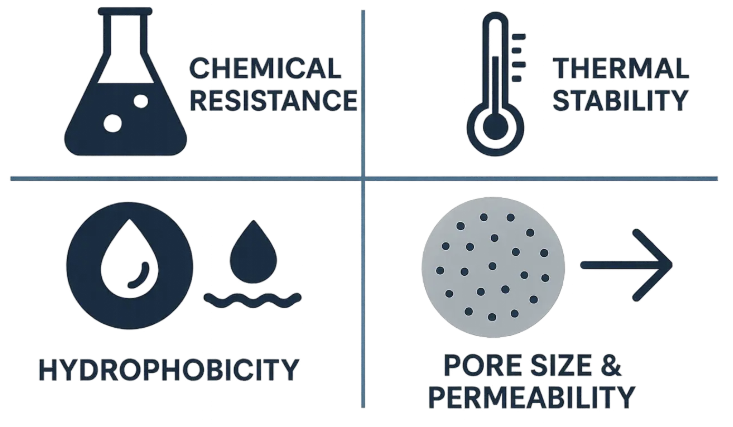
Understanding the Three Types of PTFE in Dust Filtration
1. Dipped PTFE (PTFE Impregnation)
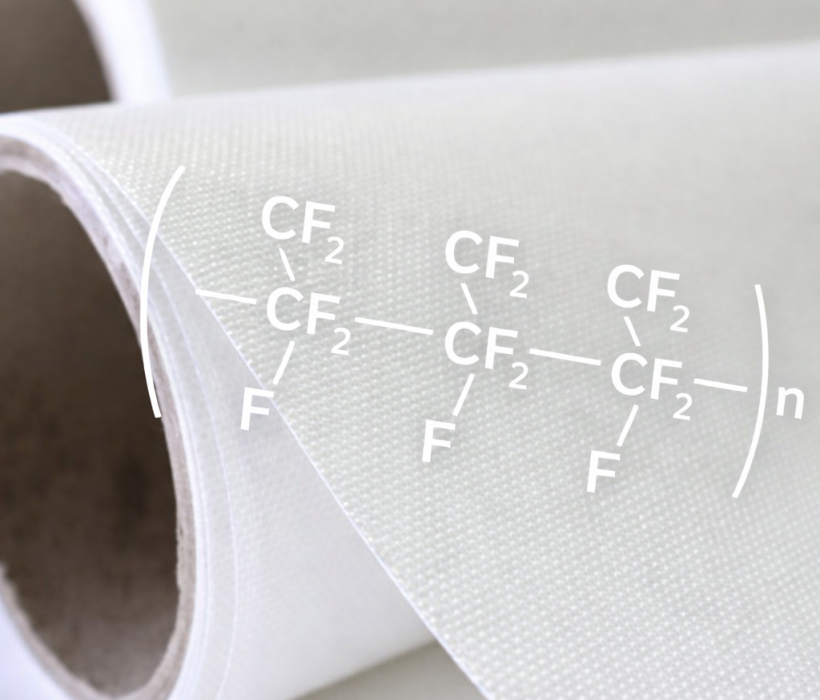
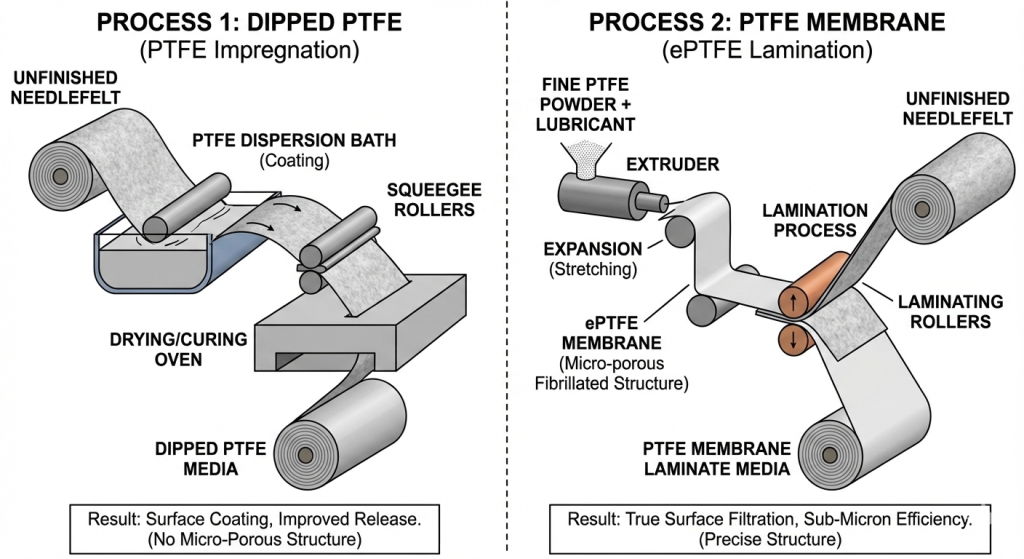
Dipped PTFE refers to needlefelt treated with a PTFE dispersion bath. This forms a surface coating that improves dust release and provides modest chemical resistance. It is the entry-level PTFE treatment and widely used across general industrial dust collectors.
Dipped PTFE is suitable for:
• Moderate-duty baghouses
• General industrial dust collection
• Low-to-medium temperature systems
• Processes with limited chemical attack
• Cost-sensitive operations where membrane performance is not required
However, it does not have a micro-porous structure, nor does it deliver membrane-level emissions control. It should not be used in systems requiring strict particulate limits, harsh flue chemistry or high stability across cleaning cycles.
Across the industry, many suppliers default to dipped PTFE because it keeps production costs low. This can create the illusion of a “PTFE upgrade” when performance remains largely unchanged.
2. PTFE Membrane (ePTFE Membrane Laminate)
PTFE membrane refers to a thin expanded PTFE (ePTFE) membrane laminated onto the surface of a needlefelt substrate. This is the true high-performance PTFE treatment, engineered with micro-porous fibrillated structures that deliver precise surface filtration.
PTFE membrane offers:
• True surface filtration
• Lower and more stable differential pressure
• Higher filtration efficiency, including sub-micron particulates
• Superior dust release
• Longer bag life
• More predictable cleaning cycles
It is the industry standard for APCS, WtE, cement, biomass, and thermal plants operating under emissions compliance frameworks.
For these environments, membrane media is no longer optional—it is essential.
FiltraCore Asia’s DFX-PTFE™ and engineered DFX™ membrane-grade series adopt this standard unless a client requires an alternative treatment.
3. ePTFE Felt (Pure PTFE Fibre and Scrim)
ePTFE felt is the premium base media, consisting of 100% PTFE fibres mechanically expanded to create a highly porous, uniform structure. It offers exceptional chemical resistance, temperature stability and structural integrity.
ePTFE felt is suitable for:
• Waste-to-Energy and incineration flue gas
• Severe acid gas and corrosive environments
• High-temperature thermal processes
• Cement kiln polishing filters
• Systems with highly variable or unstable combustion profiles
Because of the specialised manufacturing processes required, it is the costliest PTFE option. However, when paired with a PTFE membrane laminate, it forms the highest-grade dust filtration media available globally.
Use ePTFE only when the application demands it—not for the sake of overspecification.
Avoid Overspecification — The Most Common Mistake
Many suppliers attempt to sell:
-
ePTFE felt
-
PTFE membrane
-
Dipped PTFE
This “triple treatment” often costs more but provides minimal additional benefit once a membrane is applied. Membrane surface filtration already protects the underlying felt, making extra PTFE coatings largely redundant.
FiltraCore Asia’s engineering approach is disciplined:
specify the correct media based on the system realities, not the highest-priced option.
This ensures:
• Stable emissions performance
• Longer bag life
• Lower total cost of operation
• Improved cleaning cycle consistency
• Proper media-to-process matching
How PTFE Media Maps to the FiltraCore DFX™ Series
The DFX™ Series supports both standard membrane configurations and advanced PTFE media depending on baghouse conditions.
• DFX-PTFE™ — Premium PTFE membrane laminate for high-performance APCS, WtE, cement and biomass.
• DFX-PPS™ — PPS-based membrane systems for SOx-heavy or corrosive flue streams below PTFE temperature limits.
• DFX-P84™ — Engineered for high-temperature oxidative stability.
• DFX-FMS™ — Fibreglass media with advanced finishes for high-temperature duty.
• DFX-ACR™ / DFX-PES™ — Membrane-optional ranges for cost-sensitive industrial applications.
Internal recommendation rules:
Use PTFE membrane where emissions compliance and ΔP stability matter.
Use ePTFE felt only for systems with severe chemistry or aggressive thermal profiles.
Use dipped PTFE only when membrane performance is unnecessary.
Snap Band Material Selection for High-Demand APCS, Thermal & Waste-Treatment Systems
In harsh industrial environments, the performance of a dust filter bag is determined not only by its media but also by the snap band material that seals the bag to the cell plate. While many suppliers default to SS314 or SS316 snap bands, these materials are not always sufficient for advanced APCS, thermal processing or corrosive off-gas systems.
FiltraCore Asia’s engineering work across DFX™ deployments in pyrolysis, gasification, WtE, cement kiln polishing, thermal oxidisers and biomass systems reveals that snap band integrity is often the hidden cause of emissions bypass, ΔP instability or premature bag failure.
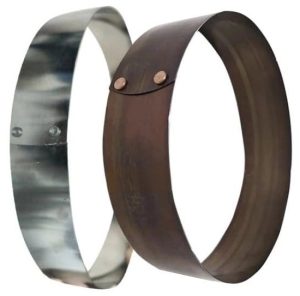
Why SS314/SS316 Snap Bands May Not Be Sufficient
1. Loss of Spring Force at Elevated Temperatures
High-temperature systems such as pyrolysis off-gas, secondary combustion chambers, thermal oxidisers and cement kiln lines cause standard SS314/SS316 snap bands to soften.
This reduces radial tension, leading to:
-
tube-sheet leakage
-
dust bypass
-
poor emissions performance
-
unstable differential pressure
2. Stress Relaxation Under Thermal Cycling
Thermally unstable systems — biomass boilers, pyrolysis units, waste incinerators — frequently cycle between low and high temperatures.
SS316 suffers stress relaxation, losing its sealing tension over time.
3. Chloride-Induced Corrosion
Chlorine-heavy environments (plastics pyrolysis, RDF combustion, chemical recycling, WtE) aggressively attack SS316.
Once pitting begins, the snap band loses integrity long before the media fails.
Why FiltraCore Specifies SUS631 (17-7PH) for DFX™ Bags in High-Demand Systems
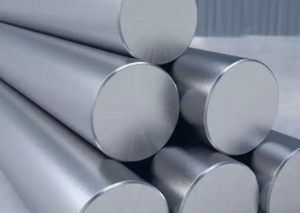
SUS631 (17-7PH) is a precipitation-hardened stainless steel built for durability under high-temperature, corrosive and high-vibration duty.
Key Engineering Benefits
1. Superior Spring Retention
Unlike 316, 17-7PH maintains high spring force even during prolonged exposure to elevated temperatures.
This ensures:
-
consistent sealing
-
minimal leakage
-
compliance-stable emissions
2. Higher Yield Strength
Prevents deformation during installation, reverse pulses or thermal expansion.
3. Resistance to Chloride Stress Corrosion Cracking
Critical for:
-
plastics pyrolysis
-
high-chloride biomass combustion
-
WtE flue gas
-
chemical recycling streams
4. Better Fatigue Resistance Under Pulse-Jet Cleaning
DFX-PTFE™, DFX-PPS™ and DFX-P84™ bags in high-pulse environments benefit from stronger snap band geometry.
Where SUS631 Snap Bands Are Recommended
DFX-PTFE™ (PTFE Membrane Media)
Mandatory when operating in:
-
pyrolysis off-gas systems
-
waste-to-energy units
-
thermal oxidisers (RTO/RCO)
-
high-chloride flue gas
DFX-PPS™ (PPS/PTFE Membrane for SOx-rich Streams)
Recommended for:
-
corrosive thermal processes
-
sulphur-heavy combustion
-
chemical recycling streams
DFX-P84™ (High-Temperature Polyimide Media)
Recommended when:
-
thermal instability exists
-
oxidation spikes occur
-
temperature cycling is rapid
DFX-FMS™ (Fibreglass High-Temperature Media)
Required in:
-
extreme temperature baghouses
-
cement kiln after-filters
-
incineration polishing filters
DFX-ACR™ and DFX-PES™
SUS631 is optional but beneficial when:
-
baghouses operate above standard design limits
-
corrosion risk is present
-
operational reliability is prioritised
Engineer-Focused Summary
• Dipped PTFE = Cost-effective coating; use for moderate duty only.
• PTFE Membrane = Industry standard; high-performance; compliance-ready.
• ePTFE Felt = Premium base media; use only where the application truly requires it.
The right choice depends on a system’s chemistry, temperature, operational profile and regulatory constraints—not on price or marketing claims.
FiltraCore Asia’s technical advisory ensures each client receives the correct media, not an oversold or underspecified option.
For engineers and researchers seeking a deeper understanding of PTFE membrane technology beyond industrial specifications, this comprehensive review on PTFE porous membranes from Journal of Membrane Science offers valuable insights into how membrane structure and processing methods influence performance. The article examines recent advances in PTFE porous membrane fabrication, pore structure control strategies, and functionalisation techniques, and highlights their practical implications in separation and filtration applications. This resource can help bridge the gap between material science fundamentals and real-world filtration challenges in APCS, environmental systems, and advanced membrane processes, making it a useful technical reference for those specifying or evaluating membrane media.
FiltraCore Asia supports engineering teams across Asia Pacific with disciplined dust filtration guidance backed by membrane-grade DFX™ solutions, technical documentation and system-aligned media selection. For project support, specifications or membrane-grade recommendations, contact our engineering team today.