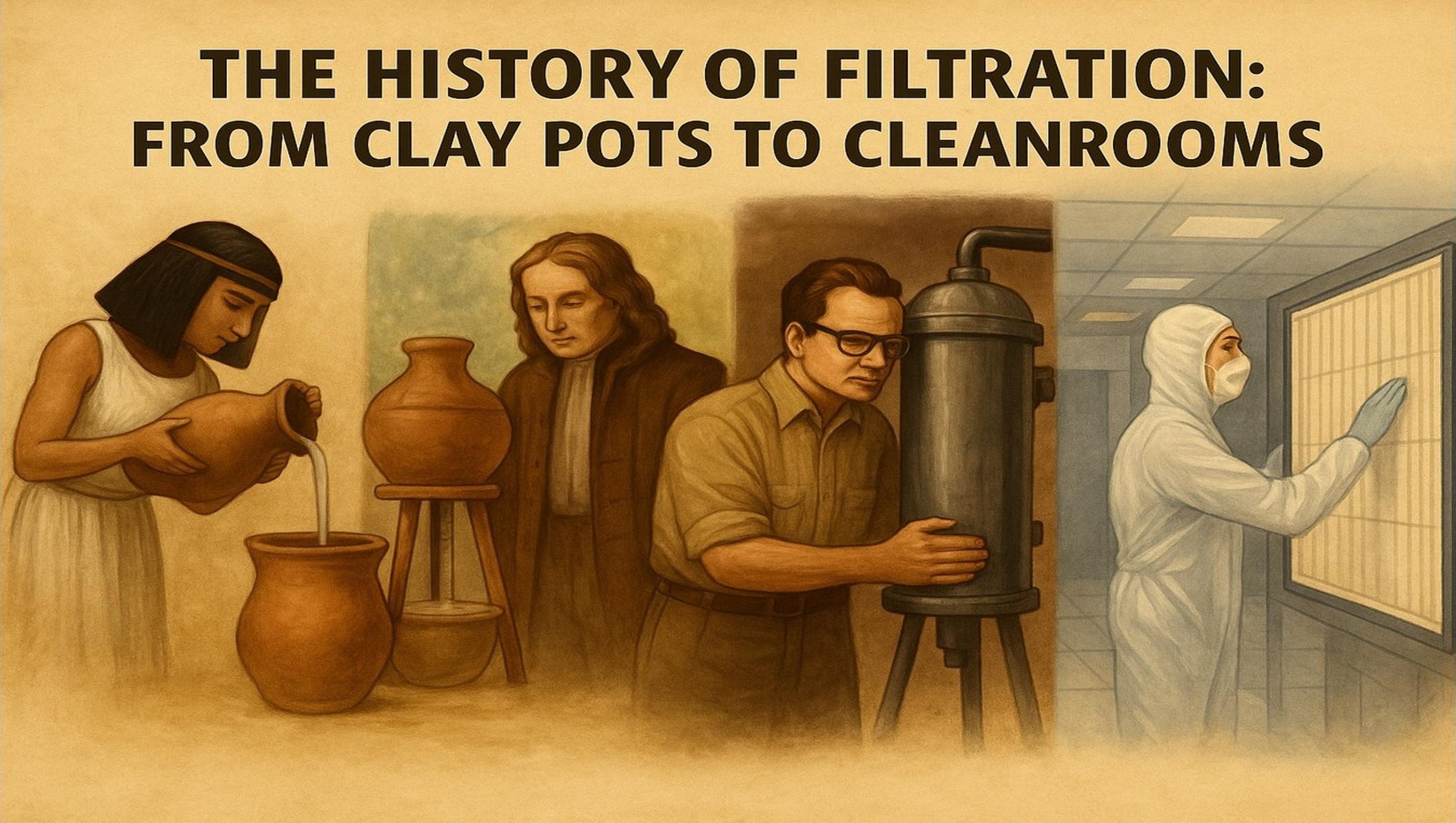
The history of filtration stretches across thousands of years, beginning with the earliest civilisations and continuing into the highly regulated, technology-driven industries we see today. What started as simple attempts to strain water with cloth, sand and porous clay has evolved into engineered systems capable of supporting pharmaceuticals, electronics, food processing, petrochemicals and advanced manufacturing. Modern companies like FiltraCore Asia continue this long tradition with solutions such as the LFX™ liquid filtration series, the DFX™ dust filtration series, AFX™ air filtration series and HFX™ stainless-steel housings, each representing the latest chapter of filtration’s ongoing evolution.
The History of Filtration in Early Civilisations
The earliest recorded history of filtration can be traced to ancient Egypt, Greece and Mesopotamia. These civilisations understood that water could be clarified using basic materials such as cloth or sand. Clay pots with porous walls acted as primitive but effective filters, slowly allowing clean water to seep through. Although rudimentary, these early methods introduced principles that remain unchanged even today: gravity flow, depth filtration and the separation of solids from liquids. The foundation behind modern LFX-PP™, LFX-PE™ and LFX-ACT™ filter bags can be directly linked to these ancient techniques.
Filtration’s Industrial Revolution: From Household Practice to Factory Necessity
During the Industrial Revolution, filtration transformed from a household practice into a critical industrial function. Factories needed cleaner water, purer lubricants and safer air. As steam engines, chemical processes and metalworking advanced, filtration systems became more sophisticated. Early versions of pressure filters, mechanical dust collectors and woven mesh systems appeared in factories worldwide. These innovations laid the groundwork for today’s industrial dust filtration technologies, including the modern DFX™ dust bag range used in cement plants, power stations, steel mills, biomass boilers, chemical processing facilities and waste incineration systems.
Scientific Advancements and the Rise of Modern Filtration Technologies
By the twentieth century, the history of filtration entered a new era of scientific development. Major breakthroughs reshaped the industry: melt-blown depth filtration became widely available, leading to the technologies behind LFX-CMB™ cartridges; pleated media designs evolved into high-surface-area filters similar to LFX-CPLEAT-PP™; and advanced membrane systems enabled microfiltration, ultrafiltration and sterilising-grade performance essential for pharmaceutical and food applications. At the same time, high-temperature fibre technologies enabled the creation of dust bags capable of withstanding extreme conditions, forming the basis for modern products such as DFX-P84™, DFX-PPS™, DFX-FMS™ and other high-performance filtration media.
Cleanrooms and High-Purity Filtration in the Modern Age
As industries demanded cleaner, safer and more sterile environments, filtration technology reached new heights. Today’s cleanrooms represent the pinnacle of the history of filtration, where even microscopic contaminants can compromise multimillion-dollar production lines. This environment relies on sophisticated systems that combine membrane performance, precision-engineered housings and advanced particulate control. PTFE membrane bags like LFX-PTFE™, activated carbon media like LFX-ACT™, high-flow cartridges such as LFX-CBIG™, and sanitary stainless-steel housings like HFX-SS-CF-SC-SAN™ all play essential roles in achieving the purity levels required for biotechnology, electronics manufacturing, aerospace, medical devices and other high-value industries.
FiltraCore Asia’s Role in the Ongoing Evolution of Filtration
Within this long historical journey, FiltraCore Asia contributes by delivering solutions that meet modern industrial expectations for clarity, safety and performance. The LFX™ series represents the culmination of centuries of liquid filtration innovation, offering advanced options in polypropylene, polyester, PTFE, activated carbon and melt-blown depth media. The DFX™ dust bag lineup continues the legacy of industrial dust collection developed during the Industrial Revolution, now enhanced with high-temperature fibres, chemical resistance, antistatic properties and optimised air-to-cloth performance. Meanwhile, the HFX™ stainless-steel housing range reflects the precision engineering that defines today’s cleanroom and process-critical systems, where reliability, hygiene and durability are non-negotiable requirements.
Why Understanding the History of Filtration Matters Today
Ultimately, studying the history of filtration is more than reflecting on the past — it reveals why modern industries depend so heavily on the reliability and performance of advanced filtration technologies. From clay pots to cleanrooms, every stage of this evolution has shaped the systems used today. Companies like FiltraCore Asia continue to push this progression forward, providing solutions that support safer production, cleaner manufacturing and higher-quality industrial output across Asia’s diverse markets.
Further Reading on the Scientific Timeline of Filtration
For readers who wish to explore additional scientific milestones in the evolution of filtration, an excellent independent timeline is available on ScienceDirect.