
Industrial Air Filtration: 7 Important Engineering Insights for Modern Facilities
By FiltraCore Asia — Technical Insights Series
Industrial air filtration is a foundational engineering control in modern facilities. It directly affects equipment reliability, energy consumption, indoor air quality, regulatory compliance, and long-term operating cost.
Across manufacturing plants, HVAC systems, cleanrooms, spray booths, electronics production, food processing, pharmaceutical facilities, and general industrial environments, poorly designed air filtration leads to unstable airflow, rising pressure drop, coil fouling, premature filter failure, and uncontrolled airborne contamination. In practice, industrial air filtration is not a “replace-the-filter” maintenance item. It is a system-level engineering decision that must align with airflow physics, dust loading, humidity, space constraints, and operating duty.
This guide explains how industrial air filtration systems behave under real operating conditions, how different filter formats perform in practice, and how FiltraCore Asia’s AFX™ Air Filtration Excellence series supports stable, predictable air handling in working facilities.
1. Treat filtration as part of the air system, not a consumable choice
Air filtration is a component of the air system’s control strategy. It governs whether airflow remains stable over time, whether coils stay clean, and whether downstream equipment and occupied zones are protected from particulate exposure.
A correctly specified filter stage helps maintain stable airflow delivery, coil and heat exchanger cleanliness, downstream component protection, contamination control, and predictable maintenance intervals. Filtration failures usually trace back to system mismatch: the wrong format, poor sealing, incorrect loading assumptions, or selection based solely on an efficiency label while ignoring face velocity and dust load.
2. Industrial Air Filtration is governed by airflow physics, not marketing ratings
Airflow is the governing variable in industrial air filtration performance. A filter that looks “excellent on paper” can fail early when exposed to excessive face velocity, uneven airflow distribution, high particulate concentration, or elevated humidity.
Engineering decisions should prioritise predictable pressure-rise behaviour over the lowest initial resistance. In real facilities, a controlled dust cake is not automatically a defect; it is often required for stable filtration efficiency. Problems arise when loading becomes uneven or structural stability is insufficient, causing local blockage, rapid pressure rise, media deformation, bypass leakage, or frame distortion.
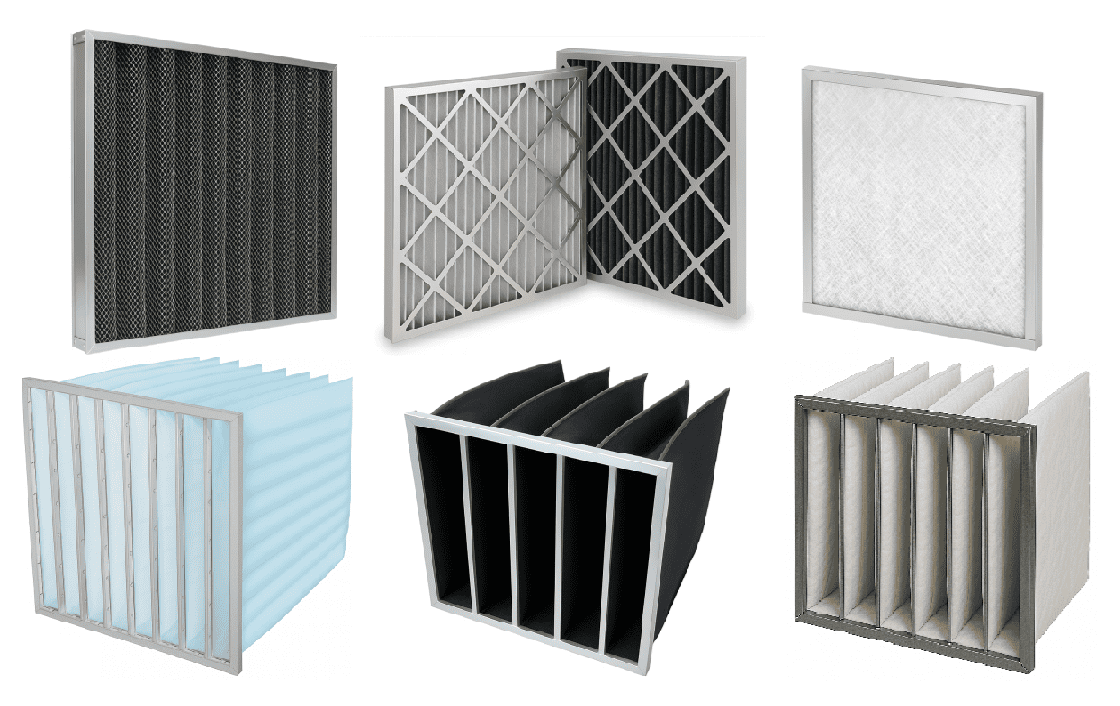
3. Match filter format to duty: pocket vs pleated vs panel
Different formats behave differently under load. The correct choice depends on dust concentration, service interval requirement, space constraints, and how stable the airflow distribution is through the filter bank.
Pocket filters are typically selected when dust loading is higher and service life needs to be extended without losing airflow stability. The deep-bed configuration distributes captured contaminants across a larger media volume, supporting controlled loading and longer run time.
Pleated panel filters provide higher surface area in a compact depth and are suited for installations with space constraints and moderate dust loads where rigidity and airflow consistency are required.
Panel filters provide cost-effective pre-filtration and protect coils and fans by intercepting larger particles early. They are not intended to carry high dust loads but are critical in extending downstream filter life.
4. Media selection is an engineering decision, not a default option
Media choice must match operating conditions and failure modes. The wrong media can create unstable pressure rise, early collapse, or performance drift under humidity and loading variability.
Synthetic fibre media is commonly used for robust dust holding and stable performance under variable humidity. Glass fibre media is selected where dimensional stability and thermal tolerance are critical. Progressive multi-layer constructions help manage loading more evenly and extend service life.
Incorrect media selection remains a leading cause of pressure instability and premature replacement.
5. Sealing and fit are as important as the filter itself
A high-grade filter installed in a poor-fit frame can perform like a low-grade filter in practice. Bypass leakage undermines filtration efficiency and makes contamination control unpredictable.
Engineering controls that matter include frame rigidity, gasket design and compression, housing flatness, installation repeatability, and avoidance of gaps or deformation in multi-filter banks. “Drop-in compatibility” must mean dimensional consistency and reliable sealing, not just nominal size matching.
6. Design for lifecycle stability, not lowest purchase cost
Facilities increasingly evaluate filtration on lifecycle cost because energy consumption and maintenance disruption dominate over time.
A stable filtration strategy reduces energy drift from rising pressure drop, reactive change-outs caused by early failure, process interruptions driven by airflow instability, and downstream contamination events caused by bypass or media blow-off.
The engineering objective is repeatable system behaviour: controlled loading, stable airflow, predictable service intervals, and reliable sealing.
7. Where FiltraCore Asia fits in Industrial Air Filtration
FiltraCore Asia’s AFX™ – Air Filtration Excellence series supports industrial air filtration applications where airflow stability, structural integrity, and predictable performance matter.
The range includes AFX-PNL™ Panel Filters for low-resistance pre-filtration, AFX-PLT™ Pleated Panel Filters for compact systems requiring consistent airflow behaviour, and AFX-PKT™ Pocket Filters for higher dust load duty and extended service life. All AFX™ filters are engineered for stable geometry under airflow stress, reliable sealing within filter banks, and drop-in compatibility with standard HVAC systems.
Conclusion: treat Industrial Air Filtration as building infrastructure
Industrial air filtration defines how facilities breathe. When engineered correctly, it protects equipment, stabilises airflow, reduces energy waste, and supports compliance. When treated as an afterthought, it becomes a recurring source of failure, cost, and operational risk.
FiltraCore Asia’s AFX™ series supports facilities seeking engineered, predictable industrial air filtration performance grounded in real operating conditions.
For readers who want to explore broader industry standards, filter ratings, and airflow mechanics, GlobalSpec provides a helpful technical reference on industrial air filtration systems. Their guide covers filter types, materials, airflow performance, and application categories—an excellent complement to FiltraCore Asia’s AFX™ overview.