
Engineering Dust Filter Media for Harsh Industrial Environments
By FiltraCore Asia — Technical Insights Series
Baghouse dust filter bag material selection is one of the most critical engineering decisions in any industrial dust collection system, especially when operating under corrosive gases, high-temperature flue streams, or environments prone to dew-point cycling.
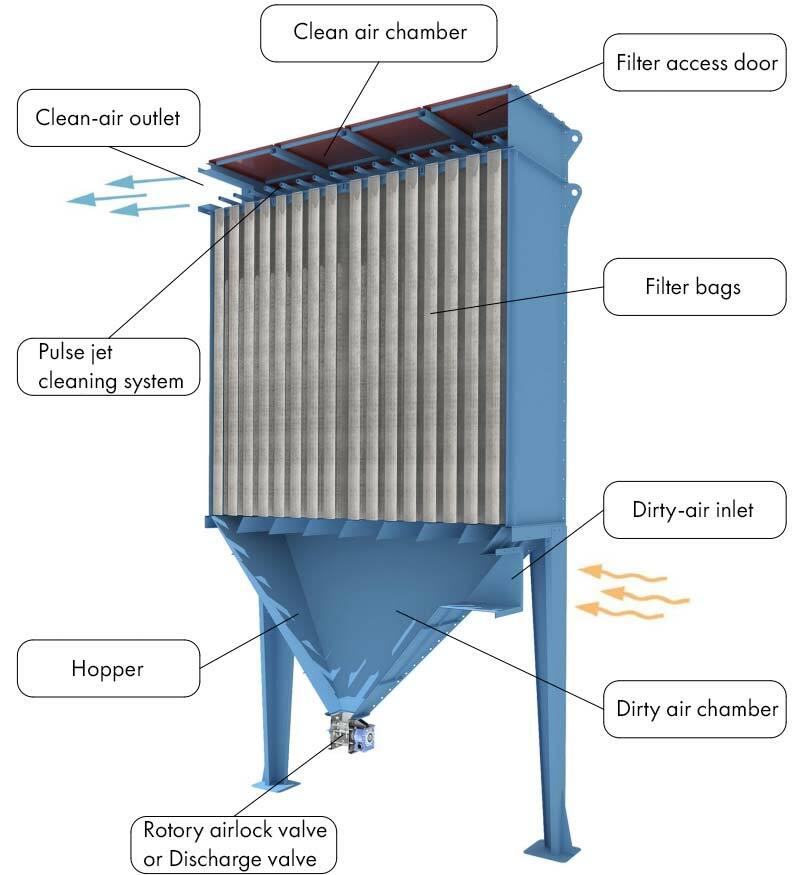

Industrial baghouses operate under some of the harshest chemical and thermal conditions in modern manufacturing. Whether the environment involves corrosive acid gases, high-temperature flue streams, sticky submicron particulates, or dew-point cycling, dust filter bags are the heart of system performance. Selecting the right baghouse dust filter bag material therefore governs bag life, pressure stability, filtration efficiency, and compliance margins.
Most plants treat dust bags as a consumable; FiltraCore Asia treats them as engineered components. Each fibre type — Polyester, Nomex®, PPS, P84®, Acrylic (ACR), Antistatic media, Fiberglass, Fiberglass Blend (FMS), or PTFE — behaves differently under heat, humidity, chemicals, and pulsing stress. The wrong choice silently drives up ΔP, accelerates blinding, and creates unplanned shutdowns. The correct choice transforms a baghouse into a predictable, stable, and long-life system.
This article provides a deep engineering analysis of all major dust bag materials, with a focus on temperature limits, chemical resistance, hydrolysis, and acid dew-point behaviour — and how each baghouse dust filter bag material should be evaluated based on real operating conditions.
Understanding the Forces Acting on a Dust Bag

Liquid bags work by depth filtration — contaminants embed inside the media.
Dust bags rely on surface filtration — a stable dust cake forms the true filtration layer.
During operation, the bag experiences:
-
continuous thermal exposure
-
pressure cycling from pulse-jet cleaning
-
chemical attacks from SOx, NOx, HCl, HF, alkalis, and oxidisers
-
moisture-temperature interactions that trigger hydrolysis
-
temperature swings ± the acid dew point, causing condensation of corrosive acids
The choice of fibre determines whether a bag survives these stresses or fails prematurely, which is why choosing the correct baghouse dust filter bag material is central to long-term performance.
A/C Ratio Behaviour across Media
While A/C ratios are ultimately determined by system design, the selected filter media strongly influences how aggressively the baghouse can operate. PTFE and PTFE-membrane bags (DFX-PTFE™) support stable performance at higher A/C ratios because they rely on pure surface filtration with excellent dust-cake release. P84® and PPS perform well at moderate A/C levels when conditions remain dry and oxidation is controlled, whereas Fiberglass and Polyester require more conservative A/C settings to minimise fibre fatigue, blinding, and premature pressure rise. A/C ratio behaviour is therefore inseparable from media choice, and FiltraCore Asia’s DFX™ family is engineered with these interactions in mind.
Hydrolysis & Acid Dew Point Cycling — The Two Silent Killers
Most premature bag failures are caused not by heat alone, but by water + acid interactions.
Hydrolysis
When moisture and heat interact with acidic or alkaline gases, polymers such as Polyester, Nomex®, and P84® undergo molecular chain scission. The felt becomes brittle, shrinks, loses strength, and eventually tears — often without visible scorching.
Acid Dew Point Cycling
SO₃, HCl, and HF vapours condense at 120–160 °C, producing micro-droplets of corrosive liquid. When the baghouse temperature repeatedly crosses this dew point, aggressive wet acid repeatedly attacks the fibres.
Only PTFE (and PTFE-laminated constructions) are fully immune to both mechanisms.
For plants facing corrosion-driven failures, FiltraCore Asia’s DFX™ Dust Filtration Excellence family includes application-matched solutions across PTFE, PPS, P84®, Fiberglass blends, Aramid (Nomex®), and Polyester media, enabling direct selection by actual operating conditions rather than generic temperature rating.
Engineering Comparison of Dust Bag Materials
Below is a consolidated engineering comparison based on temperature tolerance, chemical resistance, and real-world baghouse behaviour. Each section includes the relevant baghouse dust filter bag material under the FiltraCore DFX™ family.
1. PTFE (Polytetrafluoroethylene) — The Gold Standard
PTFE is the only fibre that is fully inert to acids, alkalis, oxidisers, solvents, and hydrolysis. It withstands 240–260 °C continuous with minimal degradation. When paired with an ePTFE membrane, it provides ultra-low emissions and stable pressure drop.
Best for:
hazardous/municipal incineration, chemical processing, smelting, TiO₂, carbon black, corrosive gas streams.
FiltraCore reference: For extreme temperature and corrosive conditions requiring the most robust baghouse dust filter bag material, specify DFX-PTFE™ — PTFE (Teflon®) Dust Bags.
2. Fiberglass (with PTFE membrane) — Best for Pure Heat
Fiberglass exceeds PTFE in peak temperature tolerance (260–280 °C) but is mechanically weaker and sensitive to alkali attack. A PTFE membrane is often required for consistent long-term stability.
Best for:
glass furnaces, high-temperature boilers, dry high-heat environments.
FiltraCore reference: For temperature-driven applications requiring a robust fiberglass-based baghouse dust filter bag material, specify DFX-FG™ or DFX-FMS™ — Fiberglass Blend Dust Bags.
3. P84® (Polyimide) — High, Dry Temperature Specialist
Excellent surface area and fine-dust capture with continuous operation around 230–240 °C.
However, severely hydrolysis-sensitive and unsuitable for wet or acidic environments.
Best for:
cement kilns, asphalt mixing, catalytic dust, dry-side carbon black.
FiltraCore reference: For high, dry-temperature processes requiring a polyimide baghouse dust filter bag material, specify DFX-P84™ — P84® Polyimide Dust Bags.
4. PPS (Ryton® / Procon®) — Chemical-Resistant Mid-Temperature Workhorse
Outstanding acid and alkali resistance, moderate temperature tolerance (160–180 °C), but limited by oxidation above ~12% O₂ at elevated temperatures.
Best for:
coal boilers, WtE (clean gas side), chemical processes with controlled oxidation.
FiltraCore reference: For mid-temperature acidic or chemical environments requiring a stable baghouse dust filter bag material, specify DFX-PPS™ — PPS (Ryton) Dust Bags.
5. Nomex® (Meta-Aramid) — Moderate Heat, Limited Chemistry
Good at 200 °C, but weak against hydrolysis and strong acids.
Suitable only for stable, moisture-controlled environments.
Best for:
asphalt plants, dryers, moderate-temperature processes.
FiltraCore reference: For moderate-temperature applications requiring aramid-based baghouse dust filter bag material, specify DFX-NMX™ — Aramid (Nomex®) Dust Bags.
6. Polyester (PE) — Low-Temperature, Low-Cost
Not suitable for harsh gas environments. Sensitive to acids, alkalis, and hydrolysis.
Best only when temperatures remain 120–135 °C and emissions are non-critical.
Best for:
general dust collection, food processing dust, woodworking.
FiltraCore reference: For low-temperature, cost-efficient applications, specify DFX-PES™ — Polyester Dust Bags as the appropriate baghouse dust filter bag material.
7. Acrylic (Homopolymer Acrylic Needlefelt) — Moisture & Acid-Resistant Low/Mid-Temperature Option
Temperature resistance up to 125–150 °C, strong resistance to acidic condensation, and excellent performance in high-humidity or corrosive low-temperature environments.
More resilient to hydrolysis than Polyester and Nomex®.
Best for:
waste incineration pre-filters, scrubber-upstream systems, high-humidity acidic dust.
FiltraCore reference: For wet acidic conditions requiring a chemically-resistant baghouse dust filter bag material, specify DFX-ACR™ — Acrylic Dust Bags.
8. Antistatic Media (Conductive Fibres or Blends) — For Static-Hazard Environments
Used where dust explosivity or electrostatic risk exists. Incorporates stainless steel fibres or conductive scrim to maintain safe surface resistivity.
Best for:
ATEX zones, explosive dust, pharmaceutical powders, metal powders, chemical dust.
FiltraCore reference: For static-sensitive processes requiring conductive baghouse dust filter bag material, specify DFX-ANT™ — Antistatic Dust Bags.
Media Selection Matrix (FiltraCore Standard Engineering Reference)
| Media | Temp (°C) | Acid/Alkali Resistance | Hydrolysis Resistance | Dew Point Tolerance | Suitable Environments |
|---|---|---|---|---|---|
| PTFE | 240–260 | Excellent | Immune | Excellent | Extreme chemistry, high-temp, corrosive gas (DFX-PTFE™) |
| Fiberglass (Pure FG) | 240–280 | Fair (alkali-sensitive) | Moderate | Moderate | High, dry heat; furnaces; boilers (DFX-FG™) |
| Fiberglass Blend (FMS) | 240–260 | Good | Good | Good | High-temperature mixed-dust environments (DFX-FMS™) |
| P84® | 230–240 | Good (dry) | Poor | Poor | High, dry heat (cement, carbon black) (DFX-P84™) |
| PPS | 160–180 | Excellent | Good | Moderate | Acidic gas, boilers, chemical dust; controlled O₂ (DFX-PPS™) |
| Nomex® (Aramid) | 190–200 | Fair | Poor | Poor | Moderate temp, dry conditions (DFX-NMX™) |
| Polyester (PE) | 120–135 | Poor | Very poor | Very poor | General dust, food dust, woodworking (DFX-PES™) |
| Acrylic (Homopolymer Acrylic) | 125–150 | Very good (acids) | Good | Good | Wet acidic dust, incineration pre-filters, scrubber-upstream (DFX-ACR™) |
| Antistatic (Conductive Blends) | Depends on base | Depends on base | Depends on base | Depends on base | ATEX zones, explosive dust, metal powders, pharma, chemicals (DFX-ANT™) |
Conclusion
Dust filter bags cannot be chosen by temperature rating alone. Real-world performance depends on how each fibre behaves under moisture, chemistry, dew-point transitions, and pulse-jet stress. PTFE remains the benchmark for severe and compliance-driven environments, while P84®, PPS, Nomex®, and Polyester each serve specialised roles depending on thermal and chemical constraints.
FiltraCore Asia engineers dust bag solutions using a technical, application-driven approach that ensures bag longevity, stable pressure drop, predictable emissions, and long-term system reliability. Our recommendations balance practicality with engineering discipline — ensuring each plant receives a media choice aligned with its actual operating conditions.
For plants evaluating upgrades or replacements across PTFE, PPS, P84®, Fiberglass, Fiberglass blends, Aramid (Nomex®), Acrylic, Antistatic media, and Polyester constructions, FiltraCore’s DFX™ Dust Filtration Excellence range provides direct, engineered options including DFX-PTFE™, DFX-PPS™, DFX-P84™, DFX-FG™, DFX-FMS™, DFX-NMX™, DFX-PES™, DFX-ACR™, and DFX-ANT™.
For readers seeking a deeper scientific foundation on fabric filter baghouses beyond the scope of this technical overview, a concise reference on ScienceDirect offers an authoritative discussion of the underlying engineering principles, operational behaviours, and research context for baghouse systems. This external resource provides valuable background on topics such as flow dynamics, particulate capture mechanisms, and comparative media performance — useful for engineers and technical decision-makers who want to augment the practical insights presented here with peer-reviewed academic context.
If your facility operates under high temperature, corrosive chemistry, or dew-point cycling — or if your baghouse is experiencing premature failures — FiltraCore Asia provides full technical evaluation, media selection guidance, and system optimisation support.
Speak with us for a performance review or a specification discussion.