Understanding Membrane Integrity in Industrial Cartridge Filtration – Bubble Point in Liquid Filtration
By FiltraCore Asia — Technical Insights Series
Bubble point membrane filter testing plays a critical role in verifying membrane integrity in modern liquid filtration systems. Whether used for fine clarification, microbial reduction, or high purity process protection, membrane cartridges must maintain consistent pore integrity to perform reliably.
One of the most widely used verification methods for bubble point membrane filter integrity is the bubble point test. This test provides a practical and measurable indicator of membrane pore structure and allows engineers to confirm that a membrane cartridge remains structurally intact.
In industrial cartridge filtration systems such as those used with the FiltraCore FiltraCore LFX C Series™, bubble point testing provides a valuable method for confirming that membrane cartridges continue to perform according to their designed filtration specifications.
What Is Bubble Point in Membrane Filtration?
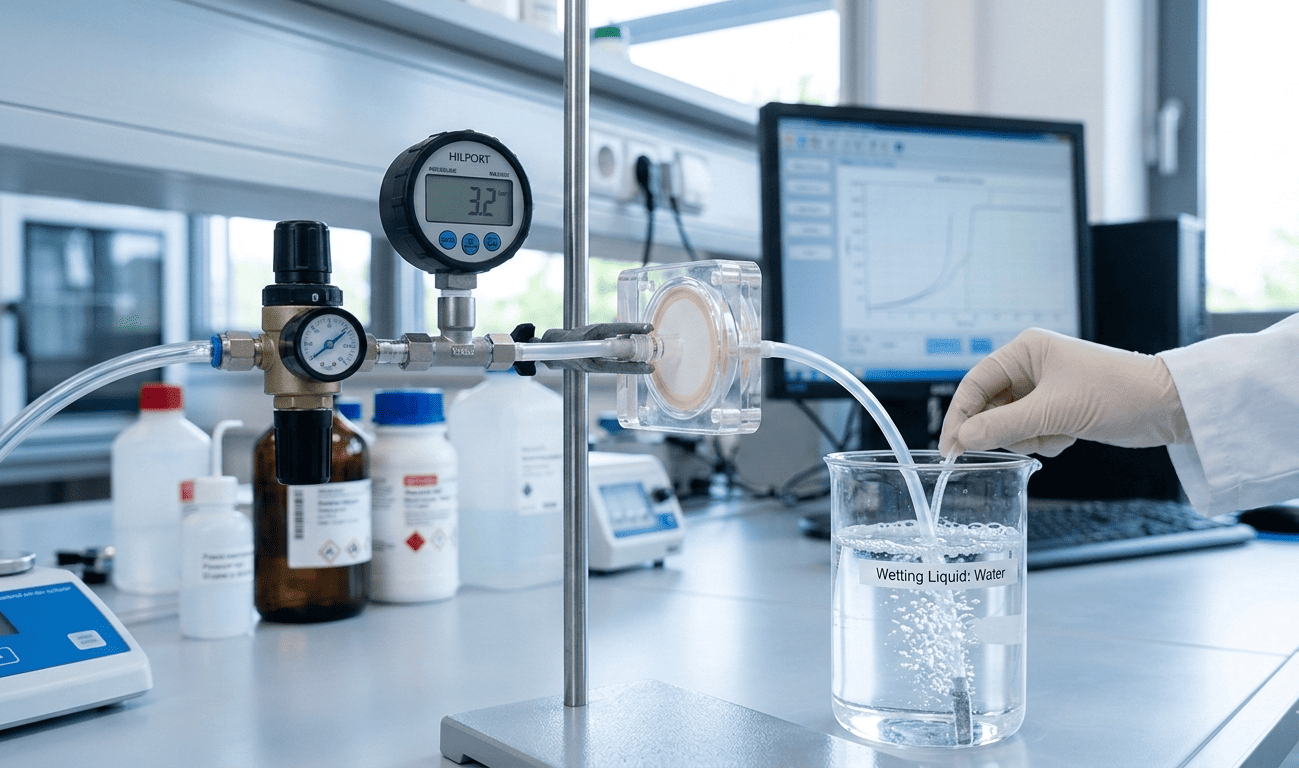
The bubble point is the minimum gas pressure required to force the first continuous stream of gas through a fully wetted membrane filter.
When a membrane is completely wetted with liquid, surface tension holds the liquid within the pores of the membrane. Gas pressure applied to the upstream side must overcome this capillary force before gas can pass through the membrane.
As pressure increases, the largest pore in the membrane will empty first. When gas begins to pass through that pore and produces a visible stream of bubbles, the corresponding pressure is known as the bubble point pressure.
Because the largest pore empties first, the bubble point provides an indirect indication of the maximum effective pore size of the membrane.
In practical testing, the bubble point must be identified as a continuous stream of bubbles emerging from the membrane surface. Localised fizzing, vortexing, or bulk foaming caused by gas diffusion does not represent the true bubble point. Only a stable and continuous bubble stream from the largest pore indicates that the capillary pressure of the membrane has been exceeded.
Bubble Point Physics: The Young–Laplace Relationship
The relationship between bubble point pressure and pore size is governed by the Young–Laplace equation, which describes capillary behaviour in membrane pores.
P = (4γ cosθ) / d
Where:
P = bubble point pressure
γ = surface tension of the wetting liquid
θ = contact angle between the liquid and membrane surface
d = pore diameter
This equation explains why smaller membrane pores require higher pressure to displace the wetting liquid. It also highlights the importance of selecting the correct wetting fluid, as surface tension and contact angle directly influence measured bubble point values.
Why Bubble Point Testing Matters
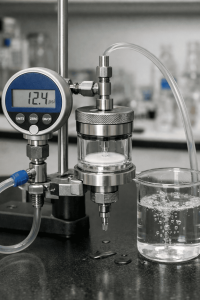 Bubble point testing is commonly used to verify membrane filter integrity.
If a membrane cartridge has been damaged, chemically degraded, improperly sealed, or mechanically stressed, the measured bubble point will fall below the expected specification.
For industrial filtration systems, this test provides several practical advantages:
• verification that the membrane structure is intact
• confirmation that the cartridge meets its pore rating
• detection of membrane damage or seal failure
• prevention of contamination caused by compromised filtration
Because the test is non-destructive, it can be performed before installation, during validation, or after filtration cycles to confirm membrane performance.
Bubble Point and Membrane Pore Size
The bubble point test is directly linked to membrane pore structure.
In practical terms:
smaller pores require higher pressure to displace the wetting liquid
This relationship allows manufacturers and engineers to verify that a membrane cartridge meets its designed filtration rating.
For example:
• 0.2 µm membranes exhibit higher bubble point pressures
• 0.45 µm membranes exhibit lower bubble point pressures
Although the exact pressure values depend on the membrane material and wetting liquid, the relationship between pore size and pressure remains consistent.
Membrane Materials Used in Industrial Cartridge Filtration
Modern industrial cartridge filtration platforms incorporate several membrane materials to address different chemical environments and filtration objectives.
Within the FiltraCore LFX C Series™ cartridge platform, pleated membrane cartridges are engineered for consistent pore geometry and predictable filtration behaviour.
Common membrane materials include:
PTFE Membrane Cartridges 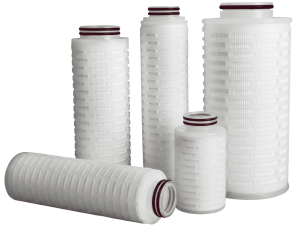
Polytetrafluoroethylene (PTFE) membranes provide exceptional chemical resistance and are widely used in aggressive chemical filtration applications.
Within the FiltraCore platform, PTFE membrane filtration is provided by:
LFX-CPLEAT-PTFE™ Pleated PTFE Membrane Filter Cartridges
These cartridges are suited for solvents, chemical processing fluids, and applications requiring high chemical compatibility.
https://filtracoreasia.com/products/hydrophobic-ptfe-membrane-pleated-cartridges/
PES Membrane Cartridges
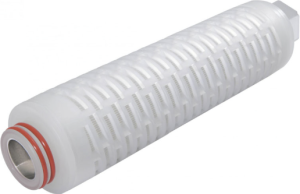
Polyethersulfone (PES) membranes are hydrophilic and well suited for aqueous filtration processes requiring stable pore structure and high flow performance.
Within the FiltraCore platform, PES membrane filtration is provided by:
LFX-CPLEAT-PES™ Pleated PES Membrane Filter Cartridges
These cartridges are commonly applied in water-based filtration systems where consistent membrane wettability is required.
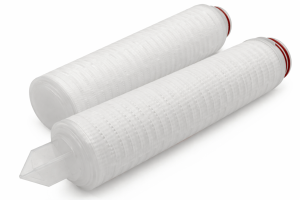
Nylon Membrane Cartridges
Nylon membrane filters are widely used for both aqueous and solvent clarification where strong mechanical strength and broad chemical compatibility are required.
Within the FiltraCore platform, this capability is provided by LFX-CPLEAT-NYLON-SF™ pleated nylon membrane filter cartridges.
Nylon membranes are naturally hydrophilic and offer reliable wetting behaviour, making them suitable for integrity testing procedures such as bubble point verification in both water-based and mixed-solvent filtration systems.
Wetting Fluids and Hydrophobic Membranes
Membrane material determines the wetting liquid used during bubble point testing.
Hydrophilic membranes such as PES can generally be wetted using water or aqueous solutions.
Hydrophobic membranes, such as PTFE, behave differently. Because the contact angle between PTFE and water exceeds 90°, water will not spontaneously wet the membrane pores.
For this reason, PTFE membranes are typically wetted using low-surface-tension liquids such as isopropyl alcohol (IPA) or IPA-water mixtures before performing a bubble point test.
Without proper wetting, the test will not produce a valid bubble point measurement.
Bubble Point vs Diffusion Testing
While bubble point testing determines the pressure required to displace liquid from the largest pore, another integrity test known as diffusion testing measures gas flow through wetted pores below the bubble point pressure.
The two methods evaluate different aspects of membrane integrity.
| Test | What It Measures | Typical Application |
|---|---|---|
| Bubble Point Test | Largest pore size within the membrane | Defect detection |
| Diffusion (Forward Flow) Test | Gas flow through wetted pores below bubble point pressure | Routine integrity monitoring |
| Pressure Decay Test | Change in pressure over time in a closed system | Automated testing for large cartridge systems |
Even when a membrane filter is fully intact, a small amount of gas can pass through liquid filled pores via molecular diffusion. This phenomenon occurs below the bubble point pressure and is governed by Fick’s law of diffusion.
Because this flow is extremely small, automated integrity testers are typically used in industrial filtration systems to distinguish between normal diffusive flow and bulk gas flow through damaged pores.
Membrane Materials Used in Industrial Cartridge Filtration
Modern cartridge filtration platforms incorporate multiple membrane materials to address different chemical, temperature, and wetting requirements.
Within the FiltraCore Asia LFX™ cartridge filtration range, filtration cartridges are engineered for industrial liquid filtration systems across manufacturing and process industries.
The LFX™ C Series range includes pleated membrane cartridges, melt blown depth cartridges, string wound filtration cartridges, carbon filtration elements, and high flow cartridges used across industrial process environments.
Two membrane materials commonly used in industrial filtration are:
PTFE Membranes
PTFE membranes offer excellent chemical resistance and are inherently hydrophobic. They are widely used for aggressive solvents, chemical processing applications, and environments requiring high chemical compatibility.
PES Membranes
Polyethersulfone membranes are hydrophilic and commonly used in aqueous filtration systems requiring high flow rates, stable pore geometry, and low extractables.
Both membrane materials rely on precise pore structure manufacturing. Bubble point testing provides confirmation that this structure remains intact during operation.
Cartridge Filtration Platforms and Membrane Stability
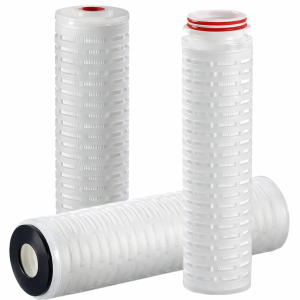 The FiltraCore LFX C Series™ cartridge platform includes multiple cartridge formats designed for industrial filtration systems.
These include:
LFX-CPLEAT-PTFE™
LFX-CPLEAT-PES™
LFX-CPLEAT-NYLON-SF™
LFX-CPLEAT-PP™
LFX-CMB™
LFX-CSW™
LFX-CACT™
LFX-CBIG™
LFX-CCL™
Within the FiltraCore LFX C Series™ platform, bubble point integrity testing applies specifically to membrane cartridges such as LFX-CPLEAT-PES™, LFX-CPLEAT-PTFE™, and LFX-CPLEAT-NYLON-SF™.
Other cartridge technologies in the series — including pleated polypropylene, melt-blown depth filters, string-wound cartridges, activated carbon cartridges and high-flow designs — rely on different filtration mechanisms and therefore use alternative validation methods.
Practical Factors That Influence Bubble Point Testing
Accurate bubble point testing depends on proper testing procedures.
Several operational factors influence test results:
• complete membrane wetting
• correct wetting fluid selection
• controlled pressure ramp rate
• stable testing temperature
• calibrated pressure instrumentation
Temperature Effects on Bubble Point Measurements
Bubble point pressure is influenced by the surface tension of the wetting liquid.
Because surface tension decreases as temperature increases, measured bubble point values will decrease slightly at higher temperatures.
For example, if testing is performed in a warm environment such as a production facility operating at approximately 35 °C, the measured bubble point may be lower than the manufacturer specification typically established at laboratory conditions of 20–25 °C.
Understanding this temperature dependence helps prevent misinterpretation of valid filters as failures during routine integrity verification.
Why Membrane Integrity Matters in Liquid Filtration
In many industrial processes, membrane cartridges represent the final filtration barrier protecting product quality or downstream equipment.
If membrane integrity is compromised:
• particulate contaminants may bypass filtration
• process fluids may become contaminated
• filtration performance becomes unpredictable
Bubble point testing provides a simple but effective method to verify that membrane cartridges remain structurally intact and capable of delivering their intended filtration performance.
Bubble point testing remains one of the most widely used techniques for verifying membrane filter integrity in liquid filtration systems.
By correlating gas breakthrough pressure with membrane pore structure, engineers can confirm that a membrane cartridge maintains its designed filtration performance.
Within industrial cartridge filtration systems such as the FiltraCore LFX C Series™, membrane cartridges including LFX-CPLEAT-PTFE™, LFX-CPLEAT-PES™, and LFX-CPLEAT-NYLON-SF™ rely on stable pore geometry and consistent manufacturing quality to deliver predictable bubble point behaviour.
For readers who want to explore the underlying theory and engineering applications of bubble point measurements in greater depth, the following external resource provides a useful technical overview. ScienceDirect summarises how bubble point testing is used to characterise porous materials and membrane filters, explaining that the method determines the pressure required to displace liquid from the largest pore in a wetted sample, thereby providing an indirect indication of pore size and membrane integrity.
If you are evaluating membrane filtration performance or integrity testing procedures in your liquid filtration system, FiltraCore Asia provides engineered cartridge filtration solutions through the LFX C Series™, including pleated PTFE, PES and nylon membrane cartridges designed for stable pore performance and consistent filtration reliability.